2026 Riot Games Tier List: Ranked Climbing Speeds Impact
The 2026 Riot Games Unified Tier List significantly reshapes ranked climbing speeds across all five divisions by balancing champion power and meta shifts, demanding adaptive strategies for players aiming for faster progression.
Are you ready to understand How the 2026 Riot Games Unified Tier List Impacts Ranked Climbing Speeds Across 5 Divisions? This pivotal update from Riot Games is poised to redefine competitive play, challenging seasoned veterans and new players alike to adapt their strategies for optimal progression in the evolving ranked landscape.
Understanding the 2026 Riot Games Unified Tier List
The 2026 Riot Games Unified Tier List represents a monumental shift in how competitive balance is managed across Riot's diverse portfolio of titles. Historically, each game maintained its own distinct balance philosophy and tier lists. This new unified approach aims to harmonize core gameplay elements, champion archetypes, and strategic considerations, creating a more cohesive ecosystem for players who engage with multiple Riot titles. This shift is not merely about consolidating data; it's about establishing a foundational set of principles that guide future champion designs, itemization, and patch cycles.
This unification isn't without its complexities. It requires a delicate balance to ensure that while core principles are shared, the unique identity and strategic depth of each game remain intact. For instance, a champion deemed 'S-tier' in one game might translate differently in another due to distinct mechanics or map layouts. The overarching goal is to foster a more predictable and understandable meta, allowing players to transfer strategic knowledge more effectively between games while still rewarding mastery within a single title.
The philosophy behind unification
Riot Games' decision to unify its tier list stems from a desire to streamline competitive play and enhance player experience. The philosophy centers on:
- Cross-Game Synergy: Identifying commonalities in champion roles and power curves across titles.
- Predictable Meta: Reducing drastic, unpredictable meta shifts by applying consistent balancing principles.
- Player Retention: Making it easier for players to transition between Riot titles without a steep learning curve for basic meta understanding.
The unified list is expected to provide clearer signals regarding champion strength, making it easier for players to identify optimal picks for climbing. However, it also introduces a new layer of strategic depth, as players must discern how these unified principles manifest within the specific nuances of their chosen game. The initial reception has been mixed, with some players welcoming the clarity and others expressing concerns about potential homogenization of gameplay experiences.
Ultimately, the 2026 Riot Games Unified Tier List is an ambitious undertaking designed to elevate the competitive landscape. Its success hinges on Riot's ability to maintain game distinctiveness while leveraging shared balancing insights, directly influencing how players perceive and interact with the meta in their quest for higher ranks.

Impact on ranked climbing speeds in Iron and Bronze divisions
For players in the Iron and Bronze divisions, the introduction of the 2026 Riot Games Unified Tier List presents both opportunities and challenges. These divisions are often characterized by a greater emphasis on individual mechanical skill and less on intricate strategic coordination. The unified tier list, by clearly delineating stronger champions, could offer a more straightforward path to improvement for those struggling to grasp complex meta concepts. Players who simply adhere to the 'S-tier' or 'A-tier' picks are likely to see a noticeable increase in their win rates, assuming they can execute basic champion mechanics.
However, the impact isn't entirely positive. The clear identification of powerful champions may lead to an even more concentrated meta within these lower ranks, where a few dominant picks are constantly contested. This could result in less diverse gameplay and potentially longer queue times if players are unwilling to adapt outside of the top-tier selections. The learning curve for these meta champions might still be too steep for some, negating the theoretical advantage of playing them.
Simplifying strategic choices
One of the primary benefits for Iron and Bronze players is the simplification of strategic choices. With a unified tier list, players can:
- Focus on fewer champions: Less time spent researching, more time mastering a core set of strong picks.
- Understand power spikes: Clearer indicators of when certain champions are at their most effective.
- Counter-picking made easier: Even basic understanding of counter-picks becomes more impactful with a streamlined meta.
The goal is to reduce cognitive load, allowing players to dedicate more mental energy to fundamental gameplay aspects like last-hitting, positioning, and basic objective control. This foundational improvement, amplified by playing strong champions, is expected to accelerate climbing speeds for a significant portion of the player base in these divisions. The unified list acts as a guiding hand, pointing players towards effective strategies without requiring extensive outside research.
In essence, the 2026 unified tier list could serve as a powerful catalyst for progression in Iron and Bronze. By providing a clear roadmap of strong champions and simplifying strategic decisions, it empowers players to focus on core mechanics and game understanding, ultimately leading to faster and more consistent ranked climbing experiences. The challenge lies in preventing meta stagnation and encouraging players to still explore different champions as they improve.
Shifts in Silver and Gold divisions due to the new tier list
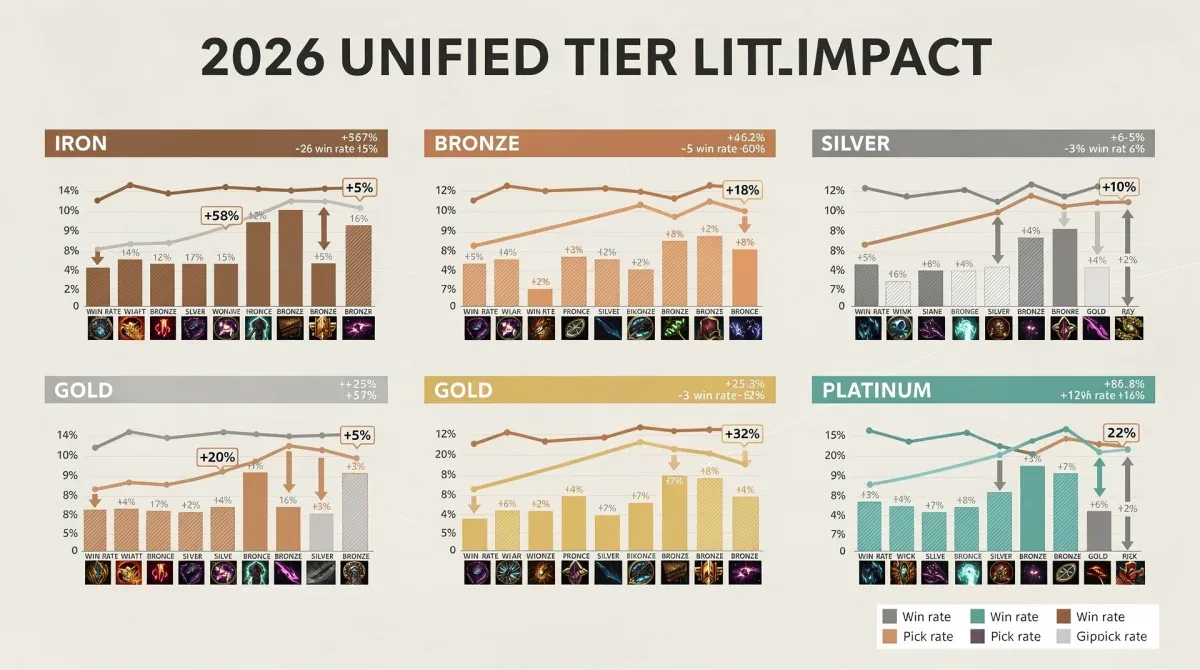
The Silver and Gold divisions, often considered the heart of the ranked ladder, are where players typically begin to grasp more complex game mechanics and team coordination. For these divisions, the 2026 Riot Games Unified Tier List is expected to induce significant shifts in climbing speeds. Players here are generally more aware of meta trends and are quicker to adapt their champion pools to capitalize on perceived strengths. The unified list provides a clear, authoritative source for identifying these strengths, potentially leading to a more volatile meta as players rapidly switch to powerful picks.
Climbing speeds in Silver and Gold could accelerate for those who are proactive in adopting tier-list champions and understanding their optimal playstyles. However, this also means that players who are slow to adapt or stubbornly stick to off-meta picks might find themselves stagnating or even falling. The unified list essentially raises the bar for meta knowledge, making it more critical than ever to stay informed and flexible with champion selections. Team compositions might also become more standardized as players gravitate towards synergistic top-tier combinations.
Adapting to meta dominance
Players in Silver and Gold will find that adapting to meta dominance is crucial. This involves:
- Frequent tier list checks: Staying updated on weekly or bi-weekly changes to the unified list.
- Champion pool flexibility: Being proficient in multiple top-tier champions for different roles.
- Understanding counter-picks: Leveraging the unified list to identify strong counter-picks against prevalent meta champions.
The unified tier list provides a common language for understanding champion power, which can facilitate better team communication and drafting strategies. A team that effectively utilizes the top-tier champions and understands their synergies will naturally have an advantage. This emphasis on meta adaptation means that individual skill, while still important, becomes increasingly intertwined with strategic meta understanding for efficient climbing.
In summary, the 2026 unified tier list will likely act as a strong determinant of success in Silver and Gold. Players who are agile in their champion selections and quick to understand the nuances of the new meta will experience faster climbing speeds. Conversely, those who resist adaptation may face steeper challenges, highlighting the importance of staying current with the evolving competitive landscape.
Strategic implications for Platinum and Diamond divisions
The Platinum and Diamond divisions represent a higher echelon of play, where individual skill is often refined, and strategic depth becomes paramount. In these divisions, the 2026 Riot Games Unified Tier List carries profound strategic implications that can significantly alter climbing speeds. Players here are not just adopting meta picks; they are dissecting *why* certain champions are strong, how to exploit their strengths, and how to mitigate their weaknesses. The unified list, while providing clear power rankings, also encourages deeper analysis of champion interactions and macro-level strategies.
Climbing speeds in Platinum and Diamond will be less about simply picking a strong champion and more about mastering that champion within the context of complex team compositions and counter-strategies. The unified tier list might streamline the initial champion selection process, but the true test lies in execution. Players who can consistently leverage the advantages of top-tier champions while simultaneously understanding how to play around their team's and opponent's compositions will see accelerated progression. This could also lead to a more defined 'pro meta' filtering down, as players emulate high-level strategies.
Advanced meta exploitation
For Platinum and Diamond players, the unified tier list enables advanced meta exploitation, which includes:
- Niche counter-picks: Identifying less obvious champions that specifically counter prevalent unified tier list picks.
- Early game dominance: Capitalizing on the early power spikes of strong champions to snowball games.
- Strategic bans: Effectively banning high-impact unified tier list champions that pose the biggest threat to their team's strategy.
The unified list serves as a foundational layer upon which advanced strategies are built. It allows for more precise theorycrafting regarding optimal team compositions, objective control, and lane assignments. Players who can consistently outmaneuver their opponents in the draft phase and execute their game plan flawlessly will find the unified tier list a powerful tool for maintaining high win rates and climbing rapidly. The competition becomes incredibly fierce, as everyone is operating with similar meta knowledge.
Ultimately, the 2026 unified tier list elevates the strategic demands in Platinum and Diamond. It pushes players to not just follow the meta, but to deeply understand and manipulate it. Those who excel in this analytical and adaptive approach will experience significantly faster climbing, solidifying their positions among the top players on the ladder.
The Ascent to Master and Grandmaster: New tier list challenges
Reaching the Master and Grandmaster divisions signifies a player's exceptional skill, game knowledge, and dedication. In these elite tiers, the 2026 Riot Games Unified Tier List introduces a unique set of challenges and opportunities that profoundly affect climbing speeds. Players at this level are not just reacting to the meta; they are often shaping it. The unified list, while providing a baseline for champion strength, will be rigorously tested and pushed to its limits by these top-tier players, who seek to uncover optimal strategies that even Riot's designers might not have foreseen.
Climbing speeds in Master and Grandmaster will be determined by a player's ability to innovate within the framework of the unified tier list. This means not only mastering the strongest champions but also identifying emergent strategies, understanding subtle power shifts, and even pioneering new approaches that can counter established meta picks. The unified list might initially homogenize the meta, but the best players will quickly find ways to diversify and gain an edge, often through unconventional but highly effective champion choices or team compositions.
Innovation and adaptation at the highest level
At the Master and Grandmaster level, innovation and adaptation are key. This involves:
- Meta breaking: Discovering and popularizing strategies or champions that defy conventional unified tier list wisdom.
- Deep understanding of patch changes: Instantly recognizing how even minor adjustments to the unified list impact gameplay.
- Team synergy mastery: Crafting compositions that leverage the strengths of unified tier list champions while minimizing their weaknesses through perfect coordination.
The unified tier list becomes a dynamic document at this level, constantly being reinterpreted and redefined by the community's top players. Climbing faster here means being at the forefront of meta development, not just a follower. It demands exceptional foresight, mechanical prowess, and the ability to communicate and coordinate complex strategies with teammates. The margins for error are incredibly slim, and every decision, from champion select to late-game objective calls, is scrutinized.
In conclusion, the 2026 unified tier list presents the ultimate proving ground for Master and Grandmaster players. While it provides a common reference point, true success and rapid climbing depend on a player's capacity for innovation, deep strategic understanding, and the ability to influence the meta itself. This makes the competition fiercely engaging and constantly evolving at the pinnacle of ranked play.
The future of meta: Adaptability and game knowledge
The introduction of the 2026 Riot Games Unified Tier List fundamentally reshapes the future of the meta across all competitive titles. This unification emphasizes two critical aspects for sustained success and efficient ranked climbing: adaptability and deep game knowledge. No longer can players rely solely on a static understanding of champion power; the unified list demands continuous learning and a flexible approach to gameplay. The meta will likely become more fluid, reacting faster to patch changes and community discoveries, making long-term mastery of a single, unchanging strategy less viable.
Players who prioritize adaptability will find themselves at a significant advantage. This means being comfortable with a diverse champion pool, understanding how different itemizations affect power curves, and being able to switch roles or playstyles based on team needs and opponent compositions. Game knowledge extends beyond just individual champion mechanics; it encompasses understanding macro-level strategies, objective control, vision manipulation, and the intricate synergies and counter-synergies between champions, items, and map states, all filtered through the lens of the unified tier list.
Cultivating a growth mindset
To thrive in this evolving meta, cultivating a growth mindset is essential. This includes:
- Continuous learning: Actively seeking out new strategies, champion builds, and meta breakdowns.
- Reviewing gameplay: Analyzing personal mistakes and identifying areas for improvement, especially concerning unified tier list interactions.
- Experimentation: Being willing to try new champions or unconventional strategies that align with the unified list's principles.
The unified tier list serves as a dynamic blueprint, not a rigid rulebook. Its existence encourages players to think critically about game balance and how changes ripple through the entire ecosystem. This fosters a more engaged and knowledgeable player base, where strategic discussions are richer and competitive play is more nuanced. The emphasis shifts from simply knowing 'what' is strong to understanding 'why' it is strong and 'how' to best utilize or counter it.
In essence, the future meta, influenced by the 2026 unified tier list, will reward the most adaptable and knowledgeable players. It's an exciting prospect for those who embrace continuous learning and strategic innovation, promising a more dynamic and intellectually stimulating ranked experience across all divisions. The journey to the top will be less about brute force and more about refined understanding and agile execution.
Community reception and professional player insights
The introduction of the 2026 Riot Games Unified Tier List has naturally sparked a wide array of reactions from the global gaming community and garnered significant attention from professional players. Initial community reception has been a mixed bag, with many players appreciating the perceived clarity and direction it offers, especially in lower ranks. They welcome the simplified approach to understanding which champions are strong, hoping it leads to a more balanced and understandable meta. However, some segments of the community express concerns about potential homogenization, fearing that the unique strategic identity of individual games might be diluted in favor of a unified approach.
Professional players, always at the forefront of competitive innovation, have provided particularly insightful perspectives. Many pros acknowledge the potential for a more streamlined competitive ecosystem, making it easier to transition between titles or to scout opponents across different games. They also highlight the new layer of strategic depth it introduces, forcing them to re-evaluate long-held assumptions about champion power and meta evolution. Some have already begun experimenting with previously overlooked champions that might benefit from the unified balancing philosophy, while others are focusing on perfecting their execution of the new top-tier picks.
Pro player strategies and adjustments
Professional players are making specific adjustments based on the unified tier list, including:
- Early meta exploration: Dedicating significant time to uncover optimal builds and playstyles for unified tier list champions.
- Cross-game expertise: Leveraging knowledge from one Riot title to inform strategies in another.
- Challenging the meta: Actively seeking out counter-strategies or 'pocket picks' that can disrupt the expected unified tier list dominance.
The insights from professional players are crucial because they not only adapt to the meta but also actively shape it. Their early adoption or rejection of certain unified tier list principles will heavily influence how the broader community perceives and utilizes the new system. Their ability to dissect the nuances of each patch and communicate their findings through streams, guides, and competitive play will be instrumental in helping the rest of the player base navigate the evolving landscape.
In conclusion, the community and professional player reception to the 2026 unified tier list is a dynamic and ongoing process. While there are legitimate concerns, the overall sentiment points towards an exciting period of adaptation and innovation. The insights from pro players, in particular, will be vital in guiding the meta's evolution and helping players across all divisions understand how best to leverage this significant change for faster ranked climbing.
| Key Impact Area | Brief Description of Tier List Effect |
|---|---|
| Iron & Bronze Climb | Simplified meta helps new players pick strong champions, potentially increasing climb speed with basic execution. |
| Silver & Gold Adaptation | Players must quickly adapt to meta shifts; proactive adoption of top-tier picks accelerates progression. |
| Platinum & Diamond Strategy | Deeper meta analysis and advanced counter-play are crucial for efficient climbing in higher ranks. |
| Master & Grandmaster Innovation | Top players innovate and shape the meta, pushing boundaries and finding emergent strategies beyond the list. |
Frequently asked questions about the 2026 Unified Tier List
What is the primary goal of the 2026 Riot Games Unified Tier List?▼The primary goal is to harmonize competitive balance across Riot's multiple titles by establishing consistent principles for champion strength and meta evolution. This aims to create a more cohesive ecosystem, simplify strategic understanding for players, and potentially accelerate ranked climbing through clearer guidance on powerful picks and strategies.
How does the unified tier list affect lower divisions like Iron and Bronze?▼For Iron and Bronze players, the unified tier list simplifies strategic choices by clearly identifying strong champions. This can accelerate climbing speeds as players can focus on mastering fewer, more impactful picks, reducing the cognitive load associated with complex meta analysis and allowing them to concentrate on fundamental mechanics.
What challenges does the unified tier list pose for Platinum and Diamond players?▼Platinum and Diamond players face challenges requiring deeper meta analysis and advanced counter-play. While the list guides champion selection, success hinges on mastering these champions within complex team compositions, exploiting subtle synergies, and adapting to sophisticated opponent strategies, demanding more than just picking a strong character.
Will the unified tier list make all Riot games feel the same?▼Riot Games aims to avoid homogenization by maintaining each game's unique identity while applying unified balancing principles. While core champion archetypes might align more closely, distinct mechanics, map layouts, and game-specific nuances are intended to ensure that each title retains its individual strategic depth and feel, preventing a uniform experience.
How can players best adapt to the new 2026 unified meta?▼Players can best adapt by cultivating a growth mindset, which includes continuous learning, reviewing gameplay, and experimenting with new strategies. Staying updated on tier list changes, diversifying champion pools, and understanding both macro-level strategies and micro-level champion interactions are crucial for navigating and succeeding in the evolving meta.
Conclusion
The 2026 Riot Games Unified Tier List marks a significant evolution in competitive gaming, fundamentally altering how players approach ranked climbing across all five divisions. From simplifying choices for Iron and Bronze players to demanding innovative strategies from Master and Grandmaster elites, this unified approach underscores the growing importance of adaptability and deep game knowledge. While challenges remain regarding meta homogenization and the continuous need for player education, the overarching goal of a more cohesive and understandable competitive ecosystem promises to enhance the player experience. Ultimately, success in the evolving landscape will belong to those who can master not just individual champions, but the dynamic interplay of a unified meta, pushing the boundaries of strategic play and achieving faster, more consistent ranked progression.
