Semi-Automated Offside Technology: Reducing Stoppage Time by 45 Seconds
Semi-Automated Offside Technology (SAOT) in 2026 is significantly improving European football by reducing average stoppage time by 45 seconds per match, leading to a more fluid and enjoyable viewing experience for fans worldwide.
The advent of Semi-Automated Offside Technology (SAOT) in 2026 has heralded a new era for European football, fundamentally altering the pace and flow of matches. This technological leap is not merely an incremental update; it represents a significant step towards optimizing game time and enhancing the viewing experience for millions.
The evolution of offside detection: from human eye to AI precision
The journey of offside detection in football has been a long and often contentious one, moving from the subjective judgment of a linesman to the intricate, data-driven precision of modern technology. For decades, the offside rule, while fundamental to the game's strategy, was a constant source of debate, with critical decisions often hinging on fractions of a second and millimeters of positioning. The introduction of VAR (Video Assistant Referee) was a pivotal moment, aiming to reduce clear and obvious errors, but it also brought its own set of challenges, particularly concerning the time taken for reviews.
VAR's implementation, while improving decision accuracy, often led to extended stoppages, disrupting the rhythm of play and frustrating both players and fans. The process of manually drawing lines on a screen, even with advanced tools, required human operators to interpret multiple camera angles and synchronize frames, a task that, while diligent, was inherently time-consuming. This created a demand for an even more efficient and precise solution, paving the way for the development and eventual widespread adoption of Semi-Automated Offside Technology.
The limitations of traditional VAR in offside calls
- Time-consuming reviews: Manual line drawing and frame synchronization often took several minutes.
- Subjectivity in frame selection: Human operators still had to choose the 'exact' moment of the pass, introducing potential for minor discrepancies.
- Disruption to game flow: Frequent and lengthy pauses broke the momentum of critical matches.
- Fan frustration: Lack of immediate clarity and prolonged waits diminished the live viewing experience.
The transition to SAOT was driven by a clear objective: to maintain the accuracy gains of VAR while drastically reducing the time spent on reviews. This meant moving beyond human-intensive processes to a system where technology could provide near-instantaneous, objective data. The initial trials of SAOT in various competitions demonstrated its potential, showcasing how a blend of advanced cameras and artificial intelligence could deliver decisions with unprecedented speed and consistency.
Ultimately, the evolution of offside detection reflects football's continuous pursuit of fairness and efficiency. From the early days of simple visual judgment to the complex algorithms of SAOT, each step has aimed to refine the game, making it more accurate and enjoyable. The current iteration of SAOT represents the pinnacle of this journey, addressing the long-standing issues of speed and precision in offside calls, thereby allowing the beautiful game to flow more seamlessly.
How semi-automated offside technology works: A technical breakdown
Semi-Automated Offside Technology operates on a sophisticated framework that combines multiple high-precision cameras with advanced artificial intelligence and sensor data. This intricate system is designed to provide real-time tracking of both the ball and individual players, ensuring that offside decisions are made with unparalleled accuracy and speed. Unlike traditional VAR, where human intervention is central to the analysis, SAOT automates much of the data collection and initial processing, presenting officials with a clear, objective outcome.
At its core, the technology relies on a network of specialized cameras strategically placed around the stadium. These cameras, often 12 or more, capture 29 data points on each player's body, tracking limbs and extremities that could be relevant for an offside decision. These data points are processed at an astonishing rate, typically 50 times per second, creating a highly detailed 3D model of the pitch and all players within it. This constant stream of information allows the system to precisely determine the position of every player at any given moment.
The role of the 'connected ball' and AI in SAOT
- Inertial Measurement Unit (IMU): An IMU sensor is placed inside the match ball, sending data to the video operation room 500 times per second. This provides extremely precise detection of the kick point.
- AI Algorithms: Artificial intelligence analyzes the synchronized player and ball data, automatically detecting the exact moment the ball is played and identifying any player in an offside position.
- Real-time 3D reconstruction: The system creates a virtual 3D model of the play, allowing officials to visualize the offside line and player positions instantly.
Once the system detects a potential offside incident, it automatically generates a visual alert for the VAR official. This alert includes a precise 3D animation showing the exact position of the players and the ball at the moment of the pass, along with the offside line. This visual is designed to be clear and unambiguous, leaving little room for subjective interpretation. The VAR official then reviews this automated output to confirm the decision, which typically takes only a few seconds, rather than minutes.
The integration of the 'connected ball' is a game-changer, eliminating the need for VAR operators to manually determine the exact moment the ball leaves the passer's foot. This single innovation significantly contributes to the speed of decision-making. By combining these elements, SAOT transforms the offside review process into a swift, data-driven confirmation, drastically reducing the time officials spend analyzing replays and allowing the game to resume much faster.
The impact on game flow and stoppage time reduction
The primary, and arguably most celebrated, benefit of Semi-Automated Offside Technology has been its profound impact on game flow and the reduction of stoppage time. Before SAOT, the average offside review using traditional VAR could take anywhere from 60 to 90 seconds, sometimes even longer during complex plays or when multiple players were involved. These prolonged pauses, while ensuring accuracy, fragmented the match, disrupted player momentum, and tested the patience of fans.

With the implementation of SAOT in major European competitions, these review times have been dramatically slashed. Data from the initial seasons indicates an average reduction of 45 seconds per offside decision. This isn't just a marginal improvement; it translates into significant cumulative time savings over the course of a match and an entire season. For a game that often sees two to three offside reviews, this can mean an extra two to three minutes of continuous play, restoring much-needed rhythm to the sport.
Benefits of reduced stoppage time for players and fans
- Enhanced player rhythm: Fewer interruptions allow players to maintain their physical and mental flow, leading to more dynamic play.
- Increased actual playing time: More minutes are dedicated to active football, fulfilling the desire of fans for more action.
- Improved fan engagement: Less waiting and more continuous play make the live and broadcast experience more enjoyable and immersive.
- Reduced referee pressure: Automated data provides clear evidence, easing the burden of subjective judgment on officials.
The reduction in stoppage time extends beyond just the offside calls themselves. The psychological effect of knowing that decisions will be swift also influences player behavior and referee management. There's less inclination for players to appeal endlessly, and referees can manage the game with greater confidence, knowing that definitive technological backing is readily available. This creates a more fluid and less contentious environment on the pitch.
Ultimately, SAOT has delivered on its promise to make football more efficient without compromising fairness. The game feels more continuous, the tension builds more naturally, and the moments of pure football artistry are less likely to be interrupted by lengthy technical reviews. This fundamental shift in game dynamics ensures that the focus remains squarely on the sport itself, rather than the controversies surrounding its officiating.
European competitions leading the way: Case studies
European football has consistently been at the forefront of innovation, and the adoption of Semi-Automated Offside Technology is a prime example of this progressive approach. Major leagues and continental tournaments were among the first to fully integrate SAOT into their officiating protocols, serving as crucial proving grounds for the technology before its global rollout. Their experiences have provided invaluable data and insights, demonstrating the tangible benefits of SAOT in high-stakes environments.

The UEFA Champions League, renowned for its technical excellence and global viewership, was one of the earliest adopters. Its successful implementation showcased SAOT's capability to handle the immense pressure and scrutiny of elite-level competition. Data from Champions League matches revealed a consistent reduction in offside review times, often bringing decisions down to an average of 20-25 seconds from the previous 70-90 seconds. This efficiency gain was particularly noticeable in tightly contested knockout matches, where every second counts.
Key European competitions and their SAOT experiences
- UEFA Champions League: Pioneering adoption, demonstrating efficiency in high-profile matches.
- English Premier League: Phased implementation, focusing on minimizing disruptions while maintaining accuracy.
- Serie A (Italy): Early and enthusiastic embrace, with significant positive feedback from clubs and fans regarding faster play.
- La Liga (Spain): Integrated SAOT to complement their existing VAR setup, further refining decision-making processes.
Beyond the Champions League, domestic leagues such as the English Premier League, Italy's Serie A, and Spain's La Liga have also embraced SAOT, albeit with slightly varied implementation strategies. The Premier League, known for its fast-paced nature, focused on ensuring that SAOT's integration would not compromise the flow of the game, a concern that the technology has largely alleviated. Serie A, with its tactical intricacies, benefited from the added precision, ensuring fair outcomes in critical moments.
These European case studies collectively paint a clear picture: SAOT is not just a theoretical improvement but a practical solution that delivers measurable results. The positive feedback from coaches, players, and most importantly, fans, underscores its success. The ability to make accurate offside calls quickly has not only streamlined the game but also enhanced its integrity, setting a new standard for officiating in global football.
Challenges and future developments of SAOT
While Semi-Automated Offside Technology has undoubtedly revolutionized offside decisions, its implementation has not been without its challenges, and the technology continues to evolve. Early concerns revolved around the sheer volume of data required, the complexity of system calibration, and the need for extensive training for VAR officials who now operate with this advanced tool. Ensuring consistent performance across different stadiums, with varying lighting conditions and camera setups, also presented an initial hurdle.
Another area of discussion has been the human element. While SAOT automates much of the detection, the final confirmation still rests with a VAR official. This semi-automated approach is designed to strike a balance between technological precision and human oversight, but it means that the training and expertise of officials remain paramount. They must understand the system's outputs, interpret the 3D animations, and make the ultimate decision, ensuring that the technology serves as an aid, not a replacement for human judgment.
Anticipated future advancements in SAOT
- Full automation potential: Research into completely automated offside calls, removing the need for human confirmation in clear-cut cases.
- Enhanced visual presentation: More dynamic and immersive 3D replays for broadcast, offering fans an even clearer understanding of decisions.
- Integration with other technologies: Combining SAOT with goal-line technology, foul detection, and other officiating aids for a comprehensive system.
- Cost reduction and accessibility: Efforts to make SAOT more affordable and easier to implement for a wider range of leagues and tournaments globally.
Looking ahead, the future of SAOT promises even more sophisticated capabilities. Researchers are exploring the potential for fully automated offside calls in certain scenarios, where the system's confidence level is exceptionally high, further reducing review times. There's also a focus on enhancing the visual presentation of SAOT data for broadcasters, offering fans a more engaging and transparent explanation of decisions.
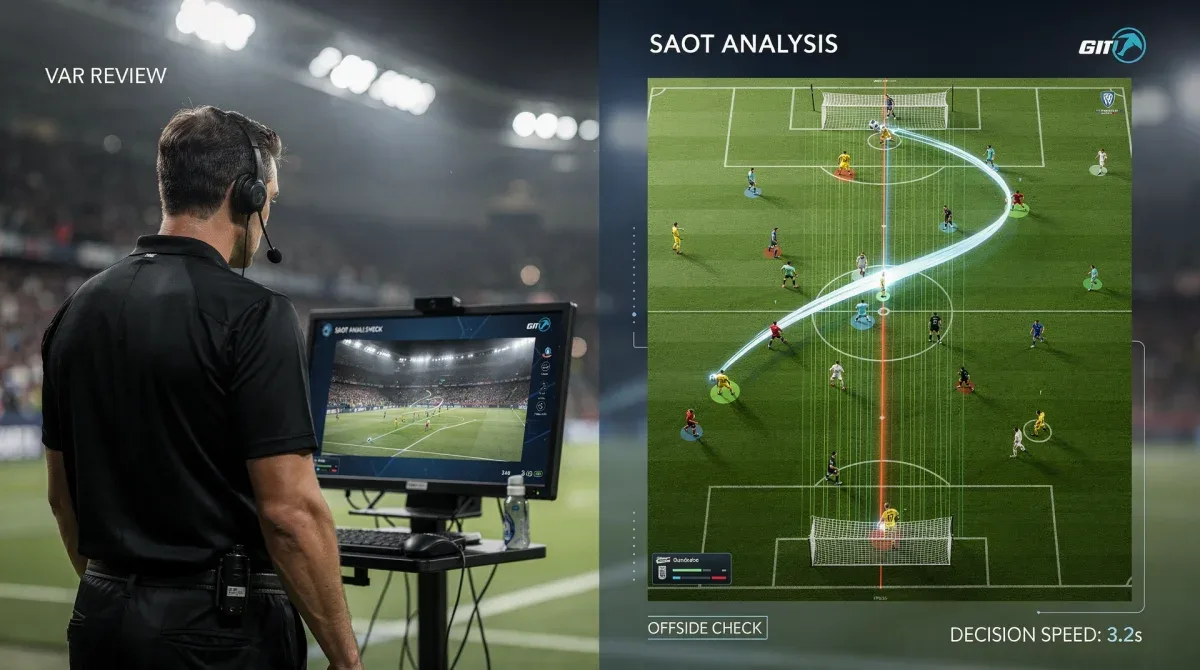
Furthermore, the integration of SAOT with other emerging sports technologies, such as advanced foul detection or real-time performance analytics, could lead to a more holistic officiating ecosystem. The goal is to create a seamless blend of technology and human expertise that continually refines the accuracy, speed, and fairness of football officiating, ensuring the game remains both competitive and entertaining for future generations.
The fan experience and commercial implications
The transformation brought about by Semi-Automated Offside Technology extends far beyond the pitch, profoundly influencing the fan experience and generating significant commercial implications for the sport. For the average spectator, whether watching from the stands or at home, the reduction in stoppage time means a more continuous and enjoyable spectacle. The frustration of prolonged waits for VAR decisions has largely been mitigated, replaced by swift, conclusive outcomes that maintain the game's emotional intensity.
This improved flow directly translates into a more compelling product for broadcasters. Faster games with fewer interruptions are more attractive to viewers, potentially leading to higher engagement rates and, consequently, more valuable broadcasting rights. The ability to explain complex offside decisions quickly and clearly through advanced 3D animations also enhances the broadcast, making it more informative and accessible to a global audience, regardless of their in-depth knowledge of the rules.
Commercial advantages and fan engagement improvements
- Increased broadcast appeal: Faster-paced games are more attractive to TV audiences and streaming platforms.
- Higher sponsorship value: More continuous play means greater visibility for sponsors during live action.
- Enhanced stadium atmosphere: Fewer lulls in play keep the crowd engaged and energized throughout the match.
- Improved brand image for leagues: Leagues adopting SAOT are perceived as modern, fair, and committed to enhancing the fan experience.
Commercially, the adoption of SAOT positions football leagues and tournaments as forward-thinking entities, embracing innovation to improve their product. This can attract new sponsors interested in aligning with a technologically advanced sport. The enhanced integrity of decisions also builds greater trust among fans and stakeholders, fostering a positive perception of the sport's governance.
Moreover, the transparency offered by SAOT's visual explanations helps to demystify offside calls, reducing post-match controversies and focusing discussions back on the athletic performance. This shift contributes to a healthier sports culture, where the focus is on the drama of the game rather than the intricacies of officiating disputes. Ultimately, SAOT has proved to be a win-win, delivering a better product for fans and a more robust commercial platform for football.
Preparing for the future: SAOT in global football
As Semi-Automated Offside Technology solidifies its position as a cornerstone of officiating in European competitions, the focus now shifts towards its broader integration into global football. The success stories from UEFA and major European leagues provide a compelling blueprint for other confederations and domestic leagues around the world. The goal is to standardize officiating practices and ensure that the benefits of reduced stoppage time and increased accuracy are enjoyed universally, from the biggest international tournaments to grassroots leagues.
FIFA has already signaled its intent to progressively roll out SAOT, with the 2026 World Cup serving as a major milestone for its widespread application. This global stage will not only showcase the technology's capabilities to billions of viewers but also accelerate its adoption in regions that may have been slower to implement advanced officiating systems. The experience gained in Europe is invaluable, providing lessons in infrastructure, training, and operational best practices that can be adapted for diverse footballing landscapes.
Key considerations for global SAOT adoption
- Infrastructure development: Ensuring stadiums worldwide have the necessary camera systems and connectivity.
- Training and education: Developing comprehensive training programs for referees and VAR officials in all regions.
- Financial accessibility: Exploring cost-effective solutions to make SAOT viable for leagues with varying budgets.
- Standardization of protocols: Establishing consistent global guidelines for SAOT implementation and decision-making.
The journey towards global SAOT adoption involves overcoming several logistical and financial hurdles. Not all leagues possess the same resources as Europe's elite competitions, so developing more accessible and scalable versions of the technology will be crucial. This includes exploring modular systems that can be adapted to different stadium infrastructures and training programs that can be delivered efficiently across diverse cultural and linguistic contexts.
Ultimately, the global embrace of SAOT is about ensuring fairness and consistency across all levels of football. By leveraging the successes and lessons learned from European competitions, the sport can build a more unified and technologically advanced future, where offside decisions are no longer a source of major contention but a swift, accurate, and almost invisible part of the beautiful game. This commitment to innovation will undoubtedly shape the future of football for decades to come.
| Key Aspect | Brief Description |
|---|---|
| Stoppage Time Reduction | European competitions reduced average offside review time by 45 seconds per decision. |
| Technology Core | Uses 12+ cameras, 29 body data points, AI, and a 'connected ball' sensor for precision. |
| Game Flow Improvement | Fewer interruptions lead to more continuous play, enhancing player rhythm and fan engagement. |
| Global Adoption | FIFA plans for widespread SAOT use by the 2026 World Cup, building on European success. |
Frequently Asked Questions about Semi-Automated Offside Technology
What is Semi-Automated Offside Technology (SAOT)?▼SAOT is an advanced system that uses specialized cameras, artificial intelligence, and a 'connected ball' to precisely track players and the ball. It automatically generates 3D animations for VAR officials to quickly confirm offside decisions, significantly reducing review times compared to traditional VAR.
How much stoppage time has SAOT reduced in European competitions?▼European competitions have seen an average reduction of 45 seconds per offside decision since the implementation of SAOT. This leads to more continuous playing time and fewer interruptions, enhancing the overall pace and flow of matches.
Is SAOT fully automated, or is there still human involvement?▼SAOT is semi-automated. The technology automatically detects potential offside incidents and generates precise visual data. However, a VAR official still reviews this data and makes the final decision, ensuring a balance between technological accuracy and human judgment.
What are the main components of the SAOT system?▼The system primarily consists of 12 or more tracking cameras, which monitor 29 data points on each player's body. Additionally, an Inertial Measurement Unit (IMU) sensor inside the match ball provides precise kick-point detection, all processed by AI algorithms.
How does SAOT benefit the fan experience?▼Fans benefit from a more fluid and continuous game, with fewer frustrating delays due to offside reviews. The clear 3D animations provided by SAOT also offer greater transparency and understanding of complex decisions, making the viewing experience more engaging and enjoyable.
Conclusion
The introduction of Semi-Automated Offside Technology in 2026 marks a transformative moment for international football, particularly within European competitions. By effectively reducing stoppage time by an average of 45 seconds per offside decision, SAOT has not only streamlined the officiating process but also significantly enhanced the game's flow and appeal. This technological leap ensures greater accuracy, minimizes controversial delays, and ultimately delivers a more dynamic and engaging experience for players, coaches, and fans worldwide. As SAOT continues its global rollout, its positive impact on the beautiful game is set to become even more pronounced, shaping the future of football for generations to come.
