Virtual Scouting Guide: Machine Learning for Undervalued Prospects
This virtual scouting guide details how machine learning metrics can be leveraged to identify undervalued professional prospects under the age of 21, providing a data-driven approach to revolutionize traditional talent evaluation in sports.
The landscape of professional sports is constantly evolving, and the search for the next generation of talent has never been more competitive. This comprehensive virtual scouting machine learning guide explores how advanced data analytics and artificial intelligence are transforming how teams identify and evaluate undervalued pro prospects under the age of 21, offering a strategic advantage in the high-stakes world of sports recruitment.
The Evolution of Scouting: From Eyeballs to Algorithms
For decades, sports scouting relied predominantly on human observation, intuition, and a network of seasoned professionals. While invaluable, this traditional approach often suffered from inherent biases, limited reach, and the sheer volume of talent to assess. The digital age, however, has ushered in a new era, one where data and technology play an increasingly critical role in talent identification. The shift towards virtual scouting represents a paradigm change, moving from subjective assessments to objective, quantifiable metrics.
This transition is not about replacing human scouts entirely but empowering them with powerful tools that enhance their decision-making capabilities. Virtual scouting allows organizations to cast a wider net, analyze a greater depth of information, and identify patterns that might be imperceptible to the human eye. It's about optimizing the talent pipeline, ensuring that promising athletes, regardless of their geographical location or immediate visibility, are given a fair and thorough evaluation based on their true potential.
The Limitations of Traditional Scouting
- Subjectivity and Bias: Human judgment, while insightful, can be influenced by personal preferences or preconceptions.
- Geographical Constraints: Scouts are limited by physical presence, potentially missing talent in remote or less-covered regions.
- Time and Resource Intensive: Extensive travel and prolonged observation periods are costly and time-consuming.
- Limited Data Points: Traditional scouting often focuses on observable skills, neglecting underlying statistical indicators of future performance.
The advent of robust data collection platforms and advanced analytical techniques has paved the way for a more scientific approach to talent assessment. This foundational shift is crucial for understanding how machine learning can be effectively integrated into the scouting process, providing a clearer, more unbiased view of a prospect's capabilities and potential for growth.
Understanding Machine Learning in Sports Analytics
Machine learning, a subset of artificial intelligence, involves algorithms that learn from data, identify patterns, and make predictions or decisions with minimal human intervention. In sports, this translates to systems that can analyze vast quantities of player performance data, movement patterns, physiological metrics, and even qualitative assessments to predict future success or identify specific player attributes. The power of machine learning lies in its ability to process complexity and uncover non-obvious correlations that elude conventional analysis.
These algorithms can be trained on historical data of successful and unsuccessful players, learning what statistical profiles and developmental trajectories lead to professional success. This predictive capability is particularly valuable when scouting young players, where raw talent needs to be distinguished from true potential that will translate to higher levels of competition. It’s about moving beyond what a player does now to what they are capable of becoming.
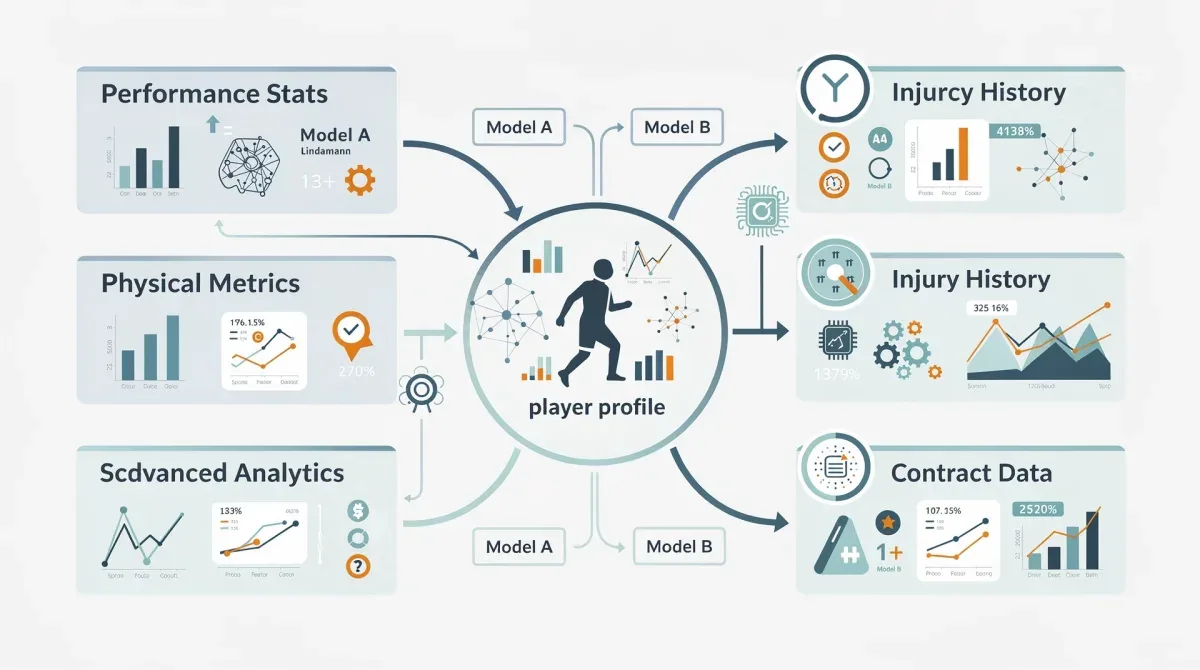
The application of machine learning in sports is not uniform; different algorithms are suited for different tasks. For instance, regression models might predict future scoring output, while classification algorithms could identify players likely to reach a certain professional league. Clustering algorithms can group players with similar playing styles, helping teams find specific archetypes to fit their tactical needs. The selection of the appropriate model is as critical as the quality of the data itself.
Key Machine Learning Applications in Scouting:
- Performance Prediction: Forecasting a player's future statistical output or overall impact.
- Injury Risk Assessment: Identifying players prone to certain injuries based on biomechanical data and historical patterns.
- Player Comparison: Finding analogous players in a database to gauge a prospect's potential trajectory.
- Role Identification: Pinpointing the most suitable position or tactical role for a player based on their skill set.
By embracing machine learning, organizations can move beyond anecdotal evidence and gut feelings, grounding their scouting decisions in empirical data. This analytical rigor not only improves the accuracy of talent identification but also helps in making more cost-effective recruitment choices, especially when targeting undervalued prospects who might not be on every team's radar.
Identifying Undervalued Prospects: The Data-Driven Edge
The concept of an "undervalued prospect" is central to gaining a competitive advantage in sports. These are players whose current performance, public perception, or traditional scouting reports do not fully reflect their true potential or future impact. Identifying such players requires looking beyond surface-level statistics and employing sophisticated analytical techniques that can uncover hidden gems. Machine learning provides the perfect toolkit for this task, allowing teams to see what others might miss.
Machine learning models can be specifically designed to detect anomalies in player data or to predict a higher future ceiling than what current metrics suggest. For instance, a player might have lower raw statistics due to playing in a less competitive league or on a struggling team, but their underlying efficiency metrics, decision-making, or physical attributes might point to elite potential. These are the nuances that machine learning excels at capturing.
Metrics Beyond the Box Score:
To identify undervalued prospects, it’s crucial to move beyond conventional box score statistics. While goals, assists, points, or tackles are important, they often don't tell the full story. Machine learning thrives on a richer dataset, incorporating advanced metrics that quantify efficiency, impact, and specific skill execution. These metrics provide a more granular view of a player's contribution and potential.
- Efficiency Ratios: Metrics that measure output relative to opportunities, such as shots per possession or successful passes per attempt.
- Advanced Tracking Data: Positional data, speed, acceleration, and deceleration can reveal tactical intelligence and physical readiness.
- Contextual Statistics: How a player performs under pressure, against specific opponents, or in different game situations.
- Skill-Specific Metrics: Dribble success rates, defensive recovery speed, passing accuracy under pressure, etc.
By integrating these diverse data points, machine learning models can build a comprehensive profile for each prospect, highlighting areas of exceptional performance or potential that might be overlooked by traditional methods. This data-driven edge is what allows teams to find players before their market value skyrockets, securing top talent at a lower cost.
Key Machine Learning Metrics for Under-21 Prospects
When evaluating prospects under 21, the focus shifts slightly from immediate impact to developmental potential. Machine learning metrics for this age group must account for growth trajectories, raw athletic ability, and indicators of future skill development. It’s not just about current performance, but about projecting how a player will evolve over the next few years, considering that physical and technical skills are still maturing.
One critical aspect is identifying 'transferable skills' – attributes that are likely to translate effectively across different levels of competition or into a professional environment. These could include decision-making under pressure, spatial awareness, adaptability, and consistent effort. Machine learning models can be trained to recognize patterns in these areas, often using proxy metrics derived from tracking data or detailed event logs.
Essential Metrics for Youth Prospect Evaluation:
- Athletic Profile: Speed, agility, strength, endurance, and explosiveness, often measured through combine data or advanced tracking.
- Technical Proficiency: Ball control, passing range, shooting accuracy, defensive technique, and consistency in fundamental skills.
- Game Intelligence: Decision-making speed, tactical awareness, off-ball movement, and ability to read the game.
- Mental Fortitude: Resilience, leadership qualities, composure under pressure, and work ethic, often inferred from consistent performance or specific in-game situations.
- Developmental Trajectory: The rate at which a player improves over time, comparing current performance to historical benchmarks for their age group.
Machine learning models can weigh these various metrics differently, depending on the sport and the specific role being scouted. For example, for a young midfielder, decision-making and passing accuracy might be weighted more heavily than raw speed, whereas for a winger, explosive acceleration might be a primary indicator. The customization and adaptability of these models are what make them so powerful in the nuanced world of youth scouting.

Implementing a Virtual Scouting System: Practical Steps
Building and implementing a robust virtual scouting system using machine learning requires a structured approach, combining technological expertise with deep sports knowledge. It's not merely about acquiring software; it's about integrating data sources, developing relevant models, and ensuring the insights generated are actionable for human scouts and decision-makers.
The first step involves data acquisition and standardization. This means collecting high-quality data from various sources – youth leagues, academies, combines, and even amateur footage – and ensuring it's in a format that can be easily processed by machine learning algorithms. Data cleanliness and consistency are paramount for the accuracy of any model. Without reliable data, even the most sophisticated algorithms will produce flawed insights.
Key Implementation Stages:
- Data Collection and Integration: Gather data from diverse sources (e.g., video analytics, wearable sensors, historical statistics, biometric data) and consolidate it into a centralized database.
- Feature Engineering: Transform raw data into meaningful features that machine learning models can understand, such as creating efficiency metrics or context-specific performance indicators.
- Model Selection and Training: Choose appropriate machine learning algorithms (e.g., regression, classification, neural networks) and train them on historical data of successful and unsuccessful prospects.
- Validation and Refinement: Rigorously test the models using unseen data to ensure accuracy and generalizability. Continuously refine models based on new data and feedback from scouts.
- Integration with Scouting Workflow: Develop user-friendly interfaces or dashboards that allow scouts to easily access and interpret the insights generated by the machine learning system.
Successful implementation also involves ongoing collaboration between data scientists, coaches, and scouts. The models need to be continually updated and retrained as new data becomes available and as the game itself evolves. This iterative process ensures that the virtual scouting system remains a cutting-edge tool for identifying the next generation of talent.
Challenges and Ethical Considerations in AI Scouting
While machine learning offers immense potential for virtual scouting, it's not without its challenges and ethical considerations. Over-reliance on algorithms without human oversight can lead to overlooking intangible qualities or unique circumstances that data alone cannot capture. The "black box" nature of some complex models can also make it difficult to understand why a particular prediction was made, leading to distrust or resistance from traditional scouts.
Data privacy is another significant concern, especially when dealing with personal and performance data of young athletes. Organizations must ensure that data is collected, stored, and used in compliance with all relevant regulations and ethical guidelines. Transparency about how data is used and how decisions are made is crucial for maintaining trust among players, parents, and coaching staff.
Addressing Potential Pitfalls:
- Bias in Data: Machine learning models can perpetuate or amplify existing biases if the training data is not representative or contains historical biases. Careful data curation and bias detection techniques are essential.
- Over-optimization: Focusing too narrowly on specific metrics can lead to overlooking well-rounded athletes or those with unconventional playing styles. A balanced approach combining data with human insight is vital.
- Ethical Use of Predictive Models: Ensuring that predictions about a young player's future do not unfairly label or limit their opportunities, especially when dealing with developmental athletes.
- Maintaining Human Element: Recognizing that character, leadership, adaptability, and mental toughness are often difficult to quantify with data and still require human assessment.
The goal should be to create a symbiotic relationship between AI and human intelligence, where technology augments human capabilities rather than replacing them. This balanced approach ensures that the scouting process remains comprehensive, ethical, and ultimately, more effective in identifying true talent.
The Future of Virtual Scouting and Talent Development
The integration of machine learning into virtual scouting is still in its early stages, but its trajectory points towards an increasingly sophisticated and influential role in talent identification and development. As data collection methods become more advanced and algorithms more refined, the ability to pinpoint undervalued pro prospects under 21 will only improve, leading to more efficient and equitable scouting processes.
Beyond just identification, machine learning will play a crucial role in personalized player development. By analyzing a player's strengths, weaknesses, and learning patterns, AI can recommend tailored training regimens, skill development drills, and even mental conditioning strategies. This individualized approach can accelerate a prospect's growth, maximizing their potential and preparing them for the demands of professional sports.
Emerging Trends:
- Real-time Analytics: Providing immediate feedback to coaches and players during training and games, allowing for instant adjustments and performance optimization.
- Predictive Health Monitoring: Using AI to anticipate injury risks and recommend preventative measures, extending player careers.
- Virtual Reality (VR) and Augmented Reality (AR) Scouting: Immersive technologies that allow scouts to virtually experience a player's performance in different game scenarios.
- Global Data Networks: Collaborative platforms where teams can share anonymized data to improve collective scouting intelligence and identify talent from underserved regions.
The future of virtual scouting is not just about finding talent, but about nurturing it. By combining the power of machine learning with human expertise, sports organizations can build more sustainable talent pipelines, giving every promising young athlete the best chance to succeed at the highest level. This evolution promises a more data-driven, fair, and exciting future for sports recruitment and development.
| Key Aspect | Brief Description |
|---|---|
| Machine Learning's Role | Algorithms analyze vast data to predict future performance and identify hidden talent, enhancing traditional scouting. |
| Undervalued Prospects | Identifying players whose potential exceeds current perception, often using advanced, non-traditional metrics. |
| Key Youth Metrics | Focus on athletic profile, technical proficiency, game intelligence, and developmental trajectory for under-21 players. |
| Ethical Considerations | Addressing data bias, privacy, and ensuring human oversight to maintain fairness and trust in AI scouting. |
Frequently Asked Questions About Virtual Scouting
What is virtual scouting in sports?▼Virtual scouting involves using data analytics, machine learning, and digital tools to identify, evaluate, and track athletic talent remotely. It moves beyond traditional in-person observation by leveraging vast datasets and predictive models to assess a player's potential and fit for a team, broadening the scope of talent identification significantly.
How does machine learning identify undervalued prospects?▼Machine learning models analyze complex patterns in player data that human scouts might miss. They can detect anomalies or project higher future performance based on underlying metrics, allowing teams to spot players whose current market value doesn't reflect their true potential, giving a competitive edge.
What types of data are used in AI-driven scouting?▼AI-driven scouting utilizes diverse data, including traditional statistics, advanced efficiency metrics, tracking data (speed, movement), physiological data from wearables, video analytics, and even qualitative reports. This comprehensive data feed enables models to build a holistic profile of each prospect for accurate evaluation.
Can machine learning replace human scouts entirely?▼No, machine learning is designed to augment, not replace, human scouts. While AI excels at data processing and pattern recognition, human scouts provide invaluable context, assess intangible qualities like character and leadership, and conduct personal interviews. The most effective approach combines both AI insights and human expertise.
What are the ethical concerns in virtual scouting?▼Ethical concerns include potential data biases leading to unfair evaluations, privacy issues related to collecting sensitive player data, and the risk of over-reliance on algorithms overlooking human elements. Ensuring data transparency, securing data, and maintaining human oversight are crucial to mitigate these challenges.
Conclusion
The integration of machine learning into virtual scouting represents a monumental leap forward in how sports organizations identify and develop talent. By leveraging advanced analytics, teams can move beyond traditional limitations, uncover truly undervalued pro prospects under 21, and build stronger, more sustainable rosters. While challenges like data bias and ethical considerations require careful navigation, the collaborative synergy between human expertise and artificial intelligence promises a future where talent identification is more precise, equitable, and ultimately, more successful.
