How 32-Team Club World Cup Reshapes Domestic Football
The expanded 32-team Club World Cup calendar profoundly impacts domestic league fixtures worldwide, creating significant challenges for scheduling, player fatigue, and the traditional balance of football competitions.
The announcement of an expanded 32-team Club World Cup calendar has sent ripples across the global football landscape, promising a seismic shift in how domestic league fixtures are structured. This ambitious new format, set to debut in 2025, presents both exciting opportunities and formidable challenges for clubs, players, and national associations worldwide.
The genesis of the expanded Club World Cup
The concept of a global club competition is not new, but FIFA's decision to transform the Club World Cup into a biennial 32-team tournament marks a significant evolution. This expansion aims to elevate the competition's prestige, commercial appeal, and global reach, bringing it closer to the scale and excitement of the FIFA World Cup for national teams. It represents a strategic move by FIFA to create a flagship club event that captures worldwide attention.
This initiative is driven by several factors, including the desire to generate new revenue streams, offer more competitive opportunities for clubs outside traditional European strongholds, and provide fans with a high-stakes, star-studded tournament. However, integrating such a massive event into an already packed football calendar is proving to be a complex undertaking, necessitating careful consideration of its ripple effects.
FIFA's vision and objectives
FIFA's vision for the expanded Club World Cup is clear: to establish a truly global spectacle that showcases the best club talent from every confederation. The objectives include:
- Increased Global Reach: Broadening the tournament's appeal beyond traditional football markets.
- Enhanced Commercial Value: Attracting more sponsors and broadcasting rights deals.
- Sporting Merit: Ensuring that qualification is based on strong performance in continental competitions.
- Player Exposure: Giving top players from various leagues a platform to compete on the world stage.
These goals, while commendable, must be balanced against the practicalities of a global football ecosystem already stretched to its limits. The sheer scale of the tournament demands a dedicated window, which inevitably encroaches upon existing domestic and continental schedules.
The expanded format moves away from the annual, shorter competition, transforming it into a more substantial, month-long event held every four years. This new structure is designed to give the tournament a more significant footprint, allowing for a group stage followed by knockout rounds, mirroring the format of the FIFA World Cup. This change alone has profound implications for fixture planning, as clubs will need to allocate a considerable block of time for participation, potentially impacting their domestic league and cup commitments.
In conclusion, the expanded Club World Cup is a bold statement from FIFA, aiming to redefine club football's global hierarchy. Its successful integration, however, hinges on navigating the intricate challenges it poses to the existing football calendar and securing the buy-in of all stakeholders.
Direct impact on domestic league schedules
The introduction of the 32-team Club World Cup calendar inevitably creates a significant scheduling crunch for domestic leagues. With a dedicated slot required for the tournament, typically in the summer months, national federations and leagues must re-evaluate their entire fixture lists. This often means compressing seasons, eliminating traditional breaks, or even reducing the number of domestic cup competitions to accommodate the new international demands.
Leagues with already tight schedules, such as the English Premier League or Spain's La Liga, face the most immediate and pronounced challenges. These leagues often have multiple domestic cups, European competitions, and international breaks to contend with, making any additional tournament a logistical nightmare. The ripple effect can be felt throughout the football pyramid, from top-tier clubs to smaller teams whose seasons might also be indirectly affected by changes in the overall calendar.
Fixture congestion and player welfare
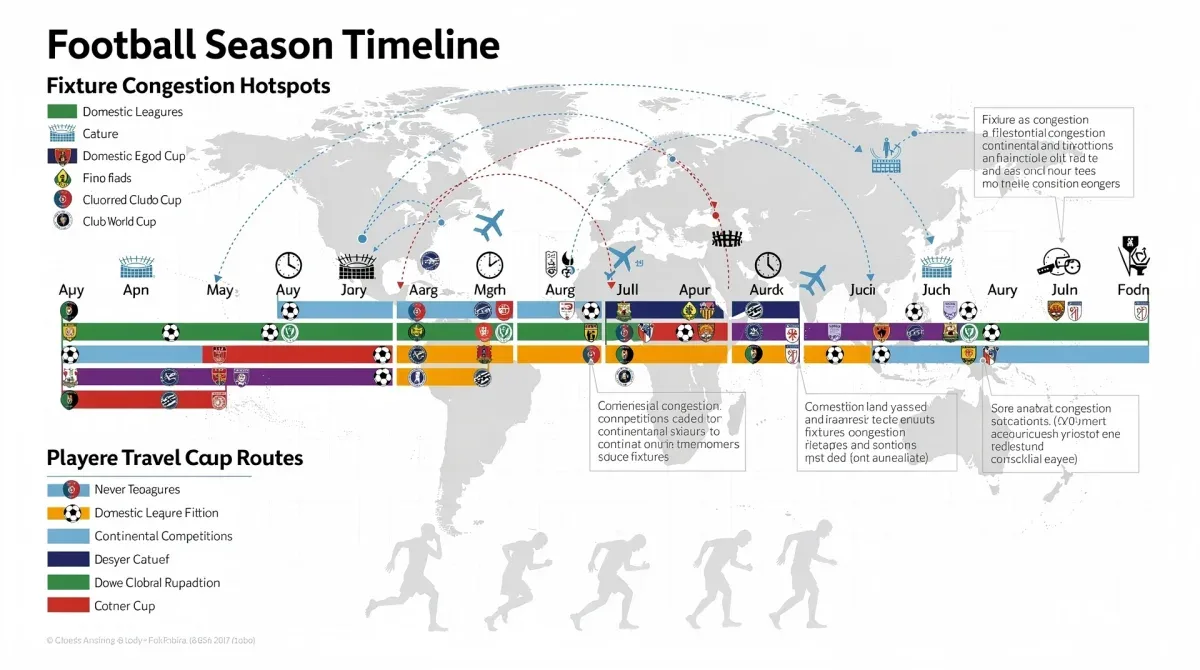
One of the most pressing concerns arising from the expanded Club World Cup calendar is the exacerbation of fixture congestion. Players are already pushed to their physical and mental limits, often playing upwards of 60 matches in a single season across various competitions. Adding a month-long, high-intensity tournament to this schedule raises serious questions about player welfare.
- Increased Injury Risk: More games in shorter periods lead to higher rates of muscle fatigue and injuries.
- Mental Burnout: Constant travel, pressure, and lack of adequate rest can lead to mental exhaustion.
- Reduced Off-Season: Players have less time for recovery and rehabilitation between seasons, impacting long-term career longevity.
- Performance Decline: Fatigue can lead to a dip in performance quality, affecting both club and national team results.
Addressing these concerns requires a collaborative effort between FIFA, continental confederations, national leagues, and player unions. Solutions might include mandatory rest periods, squad rotation policies, and potentially even adjustments to the number of matches played in domestic competitions.
The impact extends beyond just the participating clubs. Leagues must consider how to manage the absence of their top players during the Club World Cup, which could affect the competitive balance of their competitions. Some leagues might opt for a mid-season break, while others might continue, forcing clubs to rely on squad depth. This divergence in approaches could lead to further disparities in player conditioning and team performance.

Ultimately, the direct impact on domestic league schedules is a complex puzzle, requiring innovative solutions and a willingness from all stakeholders to adapt. The priority must remain the long-term health and sustainability of the sport, ensuring that players are not overstretched and that the quality of football is maintained.
Navigating international breaks and continental competitions
The expanded Club World Cup calendar significantly complicates the delicate balance between domestic leagues, international breaks for national team duties, and existing continental club competitions like the UEFA Champions League or Copa Libertadores. These elements already compete for prime scheduling slots, and adding another major tournament intensifies this pressure, demanding unprecedented coordination and compromise from all governing bodies.
International breaks, crucial for national team qualifiers and friendlies, are often non-negotiable within the FIFA calendar. Continental club competitions, being the lifeblood of many confederations, also hold immense importance and cannot be easily displaced. The Club World Cup's new slot means that one or more of these existing fixtures will inevitably need to be adjusted, leading to potential conflicts and dissatisfaction among various football stakeholders.
Challenges for continental confederations
Continental confederations face a particularly intricate challenge. Their flagship club tournaments are the primary qualification pathways for the Club World Cup. Therefore, any changes to the Club World Cup calendar directly influence their own schedules. For instance, UEFA's Champions League already has a rigorous schedule, and fitting the Club World Cup around it requires careful planning to avoid player burnout and fixture clashes.
- Re-evaluating Qualification Windows: Adjusting the timelines for continental competitions to ensure seamless qualification for the Club World Cup.
- Maintaining Prestige: Ensuring that the Club World Cup does not overshadow or devalue the importance of their own continental tournaments.
- Financial Implications: Balancing the revenue generated from their competitions with the potential financial benefits or costs associated with the Club World Cup.
These challenges are not merely logistical; they also involve political negotiations and strategic alignment between FIFA and its confederations. The success of the expanded Club World Cup depends heavily on these bodies finding common ground and a sustainable long-term calendar solution.
Furthermore, the increased travel demands for players participating in both continental and global club competitions, in addition to national team duties, raise concerns about player fatigue and injury risk. Clubs, national teams, and medical staff will need to implement more robust player management strategies to cope with the intensified schedule. This includes sophisticated rotation policies and advanced sports science support.
In summary, navigating international breaks and continental competitions requires a holistic approach to calendar management. It is a complex dance between various entities, all vying for their share of the football season, with the expanded Club World Cup now adding another major player to the stage.
Economic implications for clubs and leagues
The restructuring of the football calendar due to the 32-team Club World Cup has significant economic implications for clubs and leagues worldwide. While FIFA champions the tournament as a new revenue stream, the financial benefits and drawbacks are not evenly distributed, creating a complex economic landscape for stakeholders.
For participating clubs, the prize money and exposure from the Club World Cup could be substantial, potentially boosting their finances and global brand recognition. However, non-participating clubs and domestic leagues might face economic challenges, such as reduced gate receipts during the tournament window or decreased broadcast revenue if their star players are absent or their matches are overshadowed by the global event.
Revenue generation and distribution
FIFA's primary argument for the expanded Club World Cup is its potential to generate significant revenue. This revenue is intended to be distributed among participating clubs and confederations, creating a new economic incentive structure. However, the specifics of this distribution are crucial for understanding the overall impact.
- Prize Money: Direct financial rewards for clubs based on their performance in the tournament.
- Broadcast Rights: Global broadcasting deals are expected to be lucrative, but how these revenues trickle down to domestic leagues remains a point of negotiation.
- Sponsorship Opportunities: New global sponsorship deals could benefit FIFA, but clubs and leagues will also seek to capitalize on increased exposure.
The concern for many domestic leagues is that while FIFA and the elite clubs might benefit immensely, the broader football ecosystem could suffer. If domestic league matches are devalued or rescheduled to accommodate the Club World Cup, it could lead to a decrease in their own commercial appeal and revenue.

Furthermore, the costs associated with participation, such as increased travel, accommodation, and player insurance, must also be factored in. While the prize money might offset these costs for successful clubs, smaller clubs might find the financial burden prohibitive, even if they qualify. This could inadvertently create a deeper divide between the wealthiest clubs and the rest.
In conclusion, the economic implications of the expanded Club World Cup calendar are multifaceted. While it promises new revenue streams, careful consideration must be given to equitable distribution and mitigating potential negative impacts on domestic competitions to ensure the long-term financial health of football at all levels.
Player welfare and union perspectives
The increased demands placed on professional footballers due to the expanded 32-team Club World Cup calendar have brought player welfare to the forefront of discussions. Player unions globally have voiced concerns about the physical and mental toll this intensified schedule will take on athletes, advocating for greater protection and mandatory rest periods.
Footballers are not merely assets; they are individuals whose health and well-being are paramount. The addition of a demanding, month-long tournament to an already packed schedule raises serious questions about injury prevention, recovery times, and the overall sustainability of players' careers. Unions argue that without proper safeguards, the quality of play will suffer, and players' careers will be shortened.
Calls for mandatory rest periods and reduced fixtures
Player unions, such as FIFPRO, have been vocal in their demands for concrete measures to protect player welfare. Their proposals often center on establishing mandatory rest periods and, in some cases, advocating for a reduction in the total number of fixtures across all competitions.
- Minimum Off-Season Break: Ensuring players receive a guaranteed number of weeks of complete rest between seasons.
- In-Season Breaks: Implementing short breaks during the season to alleviate fatigue.
- Squad Limits: Encouraging clubs to maintain larger squads to facilitate rotation and reduce individual player workload.
- Medical Monitoring: Enhancing medical surveillance and sports science support to track player load and prevent injuries.
These measures are seen as essential to mitigate the risks associated with fixture congestion. Without them, the expanded Club World Cup calendar could lead to an epidemic of injuries and a decline in the overall quality of football, as fatigued players struggle to perform at their peak.
The dialogue between player unions, FIFA, and national associations is ongoing and critical. Striking the right balance between commercial ambitions and player well-being is a complex negotiation. Any sustainable long-term solution must prioritize the health of the athletes who are at the heart of the sport. Ignoring these concerns could lead to player strikes or a general decline in the attractiveness of the game due to lower performance levels.
In conclusion, player welfare is a non-negotiable aspect of the expanded Club World Cup. The perspectives of player unions highlight the urgent need for a more humane and sustainable football calendar that protects athletes from excessive demands and ensures their long-term health and performance.
Potential solutions and future outlook
Addressing the challenges posed by the expanded 32-team Club World Cup calendar requires innovative thinking and a willingness from all football stakeholders to collaborate on sustainable solutions. There is no single magic bullet, but a combination of strategic adjustments and a shared commitment to the long-term health of the sport can pave the way for a more balanced calendar.
One primary area for consideration is the optimization of existing domestic and continental schedules. This might involve reducing the number of matches in certain competitions, rethinking the format of domestic cups, or streamlining international breaks. The aim is to create sufficient breathing room for the Club World Cup without unduly compromising other vital components of the football calendar.
Collaborative calendar reform
A truly effective solution will likely emerge from a collaborative effort involving FIFA, continental confederations, national leagues, clubs, and player unions. This approach would involve:
- Joint Task Forces: Establishing committees to develop a unified global football calendar.
- Data-Driven Decisions: Using sports science data to inform decisions about player load and recovery.
- Flexible Scheduling: Allowing leagues some flexibility in how they integrate the Club World Cup into their calendars, considering regional specificities.
- Revenue Sharing Models: Developing equitable models for revenue sharing that benefit all levels of football, not just the elite clubs.
Such a reform would need to be comprehensive, looking beyond just the immediate impact of the Club World Cup and considering the entire ecosystem of professional football. It's about creating a calendar that is not only commercially viable but also sustainable for players and engaging for fans.
The future outlook for the global football calendar is one of dynamic change. While the expanded Club World Cup brings challenges, it also presents an opportunity to collectively reassess and potentially improve the structure of international football. The hope is that through careful planning and open dialogue, a calendar can be forged that respects player welfare, maintains the integrity of domestic leagues, and delivers exciting, high-quality football to fans worldwide.
Ultimately, the success of the new Club World Cup calendar will be measured not just by its commercial returns, but by its ability to integrate seamlessly into the existing football landscape, enhancing the sport without overburdening its participants. The coming years will reveal whether football's governing bodies can rise to this complex challenge and forge a truly harmonious global calendar.
| Key Impact Area | Brief Description |
|---|---|
| Domestic League Fixtures | Requires significant rescheduling, compression, or reduction of existing domestic competitions. |
| Player Welfare | Increased fixture congestion heightens injury risk and mental fatigue, demanding more rest. |
| Economic Implications | Potential new revenue for FIFA and participating clubs, but challenges for non-participating leagues. |
| Global Calendar Coordination | Requires unprecedented collaboration between FIFA, confederations, and leagues for integration. |
Frequently asked questions about the Club World Cup calendar
When is the expanded 32-team Club World Cup scheduled to take place?▼The expanded 32-team Club World Cup is set to debut in the summer of 2025. It will then be held every four years, taking a significant slot in the international football calendar. This schedule aims to establish it as a premier global club competition.
How will the new Club World Cup affect domestic league schedules?▼The new Club World Cup will necessitate significant adjustments to domestic league schedules. Leagues may need to compress their seasons, eliminate mid-season breaks, or reduce the number of domestic cup competitions to accommodate the month-long tournament, leading to increased fixture congestion.
What are the main concerns regarding player welfare with the expanded calendar?▼Player welfare concerns include increased risk of injuries due to fixture congestion, mental and physical fatigue from constant travel and demanding matches, and reduced off-season recovery time. Player unions are advocating for mandatory rest periods and stricter player protection measures.
Will the Club World Cup expansion benefit all clubs equally?▼While participating clubs may gain significant prize money and global exposure, the benefits are unlikely to be equal. Non-participating clubs and domestic leagues might face economic challenges due to disrupted schedules or reduced attention, potentially widening the financial gap in football.
What solutions are being considered to manage the new global calendar?▼Potential solutions include collaborative calendar reform involving FIFA, confederations, and leagues, implementing mandatory player rest periods, optimizing existing domestic schedules, and developing equitable revenue-sharing models. The goal is to create a sustainable and balanced global football calendar.
Conclusion
The advent of the expanded 32-team Club World Cup calendar undeniably marks a pivotal moment for global football. While promising enhanced spectacle and new revenue streams, its integration into an already dense schedule presents formidable challenges across domestic leagues, player welfare, and economic equity. Navigating these complexities demands unprecedented collaboration among all stakeholders – FIFA, continental confederations, national leagues, and player unions. Only through a unified, forward-thinking approach can the sport truly harness the potential of this new tournament while safeguarding the integrity of existing competitions and, critically, the well-being of its athletes. The coming years will be a testament to football's capacity for adaptation and its commitment to a sustainable future.
