Box-to-Box Midfielder vs. 4-3-3: Passing Metrics Guide
This guide provides an in-depth tactical analysis of the modern box-to-box midfielder's performance against 4-3-3 defensive formations, emphasizing crucial passing metrics for effective playmaking and defensive disruption.
Understanding the intricate role of a modern box-to-box midfielder is paramount in contemporary football, especially when facing the disciplined structure of a 4-3-3 defense. This box-to-box passing metrics guide delves into the tactical nuances and analytical insights required for these dynamic players to dominate the midfield battleground.
The Box-to-Box Midfielder's Evolving Role
The box-to-box midfielder has transformed significantly over the decades, moving from a purely energetic ball-winner to a sophisticated orchestrator capable of influencing both defensive and offensive phases. Against a 4-3-3, their ability to cover ground, win duels, and distribute the ball under pressure becomes even more critical. Their role is not just about physical exertion but also about tactical intelligence and precise execution of passes.
Modern football demands versatility, and the box-to-box player embodies this. They are the engine room, providing a link between defense and attack, often dictating the tempo of the game. Their positional awareness is key to disrupting opposition patterns and creating opportunities for their own team. Without a strong presence in this role, a team can easily be overrun in the central areas, particularly against a well-drilled 4-3-3.
Understanding the 4-3-3 Defensive Structure
- Compact Midfield Triangle: The 4-3-3 often features a narrow midfield, aiming to deny central progression and force play wide.
- High Pressing Triggers: Teams employing a 4-3-3 frequently initiate a high press, with the front three and central midfielders hunting the ball.
- Wing-Back Overlaps: While primarily defensive in this context, full-backs can push high, leaving space behind them that a box-to-box midfielder can exploit.
In conclusion, the box-to-box midfielder's evolution highlights their indispensable nature in modern football. Their blend of athleticism, technical skill, and tactical acumen is crucial for navigating the challenges posed by formations like the 4-3-3, turning defensive solidity into attacking impetus.
Analyzing Key Passing Metrics for Impact
Beyond simply completing passes, the quality and intent behind each pass define a box-to-box midfielder's true impact. Against a 4-3-3, where space is often at a premium, understanding and optimizing specific passing metrics can be the difference between stagnated play and fluid transitions. These metrics offer a deeper insight into how effectively a player contributes to ball progression and chance creation, rather than just retaining possession.
Traditional passing completion rates, while important, don't tell the whole story. A player can have a high completion rate by playing safe, sideways passes. What truly matters for a box-to-box midfielder is their ability to break lines, create danger, and initiate attacks, all while maintaining possession in critical areas. This requires a nuanced look at different types of passes and their outcomes.
Essential Passing Metrics
- Progressive Passes: Passes that move the ball significantly closer to the opponent's goal. These passes are vital for breaking the lines of a compact 4-3-3.
- Key Passes: Passes that directly lead to a shot on goal. A high number indicates a player's ability to create genuine scoring opportunities.
- Through Balls: Passes played into space for an attacking player to run onto, often piercing the defensive line.
- Expected Assists (xA): A metric that quantifies the probability of a pass becoming an assist based on the quality of the chance it creates. This provides a more accurate measure of creative contribution.
- Long Pass Accuracy: The ability to accurately switch play or find teammates over long distances, which can be effective in stretching a narrow 4-3-3.
These metrics, when analyzed collectively, paint a comprehensive picture of a box-to-box midfielder's passing efficacy. They move beyond simple volume to evaluate the strategic value of each pass, highlighting players who are not just busy but genuinely effective in advancing the team's agenda against structured defenses.

Tactical Adjustments to Counter 4-3-3 Pressure
Facing a 4-3-3 defense demands specific tactical adjustments from the box-to-box midfielder to mitigate pressure and exploit weaknesses. The midfield battle is often won or lost based on how effectively these players can navigate the opposition's pressing schemes and find avenues for progression. It's about smart positioning, quick decision-making, and exploiting the inherent risks a 4-3-3 takes.
One primary strategy involves creating numerical superiority in central areas, even if temporarily. This can be achieved through clever rotations and dropping deeper to receive the ball, drawing out opposition midfielders and opening up space for teammates. The box-to-box midfielder must be adept at recognizing these moments and executing the correct response under duress.
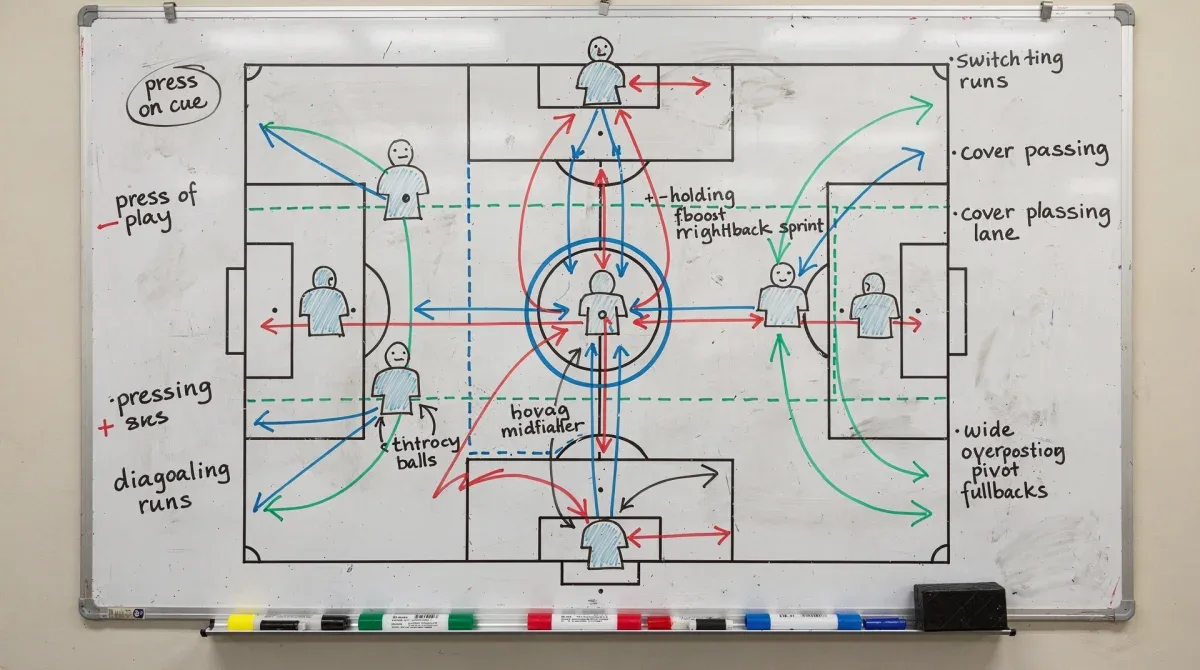
Exploiting Half-Spaces and Channels
The half-spaces, the areas between the center-back and full-back, are often vulnerable points in a 4-3-3. A box-to-box midfielder can make late runs into these areas or deliver precise passes to wingers or forwards positioned there. This requires excellent vision and timing to thread the needle through tight defensive blocks.
- Vertical Passes: Prioritize passes that break lines and penetrate the opposition's midfield and defensive units, rather than horizontal possession.
- Quick Combinations: Engage in rapid one-two passes or triangles to bypass pressing players and create momentum.
- Positional Rotations: Swap positions with attacking midfielders or wingers to confuse markers and open up new passing lanes.
Another crucial adjustment is the ability to play out of pressure with composure. When a 4-3-3 presses high, it leaves space behind its front line. A well-timed pass over the top or a quick switch of play can bypass multiple defenders and launch a dangerous counter-attack. The box-to-box midfielder must be the one to spot these opportunities and execute them with precision.
Ultimately, tactical adjustments against a 4-3-3 revolve around intelligent movement, precise passing, and the bravery to take calculated risks. The box-to-box midfielder, with their comprehensive skill set, is ideally placed to lead these efforts, turning defensive challenges into attacking advantages and dictating the flow of the game.
The Role of Vision and Decision-Making in Passing
Beyond the technical execution of a pass, the underlying vision and decision-making capabilities of a box-to-box midfielder are paramount. Against a 4-3-3, where defensive blocks are tight and pressing is intense, the ability to quickly assess options and choose the most impactful pass can dictate the success of an entire attacking sequence. This cognitive aspect of the game is what separates good midfielders from truly exceptional ones.
A midfielder's vision isn't just about seeing open teammates; it's about anticipating defensive movements, understanding the flow of the game, and predicting where space will open up. This foresight allows them to play passes that unlock defenses before they fully organize. Poor decision-making, on the other hand, can lead to turnovers in dangerous areas, inviting counter-attacks from the opponent.
Improving Vision and Decision-Making
- Scanning the Field: Constantly look around before and after receiving the ball to build a mental map of player positions and available space.
- Anticipation: Learn to read the game, predicting where defenders will move and where teammates will run, to play passes into advantageous areas.
- Pre-meditation: Develop the habit of planning the next action before the ball arrives, considering multiple passing options.
- Risk Assessment: Understand when to play a safe possession pass and when to attempt a more ambitious, line-breaking pass, balancing risk with potential reward.
Decision-making is also heavily influenced by the speed of play. In a fast-paced game against a high-pressing 4-3-3, there is often minimal time to think. Box-to-box midfielders must train to make optimal decisions under intense pressure, relying on instinct and pattern recognition developed through practice and experience. The ability to process information rapidly and execute a precise pass is a hallmark of elite players.
In essence, vision and decision-making are the intellectual engines driving a box-to-box midfielder's passing game. They enable players to not just execute passes but to truly influence the game's tempo and direction, creating opportunities where none seem to exist against a disciplined 4-3-3 formation.
Training Drills to Enhance Passing Metrics
To truly master the art of passing against a 4-3-3, box-to-box midfielders must engage in targeted training drills that simulate game-like scenarios and focus on improving specific passing metrics. Generic passing drills, while foundational, often fall short in preparing players for the unique pressures and tactical demands of facing a compact, high-pressing opponent. Training must be specific, intense, and decision-making oriented.
The goal of these drills is not just to improve technical skill but also to enhance cognitive processing under pressure. Players need to be able to identify passing lanes, execute passes with appropriate weight and direction, and make quick decisions, all while being challenged physically. This holistic approach ensures that improvements in training translate directly to performance on the pitch.

Recommended Drills for Passing Excellence
- Box-to-Box Progression Drill: Set up two small goals at opposite ends of a central zone. Midfielders must receive the ball from defenders, make progressive passes to forwards, and then transition to defend. This simulates the rapid offensive-to-defensive transitions.
- Line-Breaking Pass Rondo: A rondo with defenders actively trying to intercept passes. The objective is to consistently play passes through the defensive lines to teammates on the other side, focusing on speed and accuracy.
- Weighted Pass Challenge: Players must pass into target zones or to moving targets, with points awarded for accuracy and appropriate pass weight. This helps in delivering through balls and long switches of play.
- Decision-Making Scrimmages: Small-sided games where specific passing restrictions or objectives are introduced, e.g., 'must play a progressive pass within three touches' or 'score only after a key pass'.
Incorporating video analysis of these drills can further accelerate learning. Players can review their performance, identify areas for improvement, and understand how their passing choices impact the team's overall play. This feedback loop is essential for continuous development and for internalizing the principles of effective passing against challenging defensive setups.
By consistently engaging in these specialized training drills, box-to-box midfielders can significantly enhance their passing metrics and tactical understanding. This focused approach ensures they are well-equipped to break down even the most stubborn 4-3-3 defenses, becoming pivotal figures in their team's success.
Integrating Defensive Responsibilities with Passing Prowess
The modern box-to-box midfielder is a complete player, meaning their offensive passing prowess must be seamlessly integrated with their defensive responsibilities. Against a 4-3-3, their ability to recover possession, shield the defense, and then immediately launch an attack through incisive passing is a defining characteristic. It's a continuous cycle of winning the ball and distributing it effectively.
Defensive duties often involve pressing the opposition's central midfielders, tracking runners, and intercepting passes. Once possession is regained, the transition to attack must be swift and intelligent. A successful box-to-box midfielder doesn't just clear the ball; they look for the best passing option to initiate a counter-attack or retain possession in a advantageous position.
Balancing Defense and Offense
- First Pass After Turnover: The quality of the first pass after winning possession is crucial. It dictates whether the team can transition quickly or if the ball is lost again.
- Positional Discipline: Maintain defensive shape when out of possession to prevent the 4-3-3 from exploiting gaps, but be ready to burst forward once the ball is won.
- Pressing Triggers: Understand when and how to press the opposition's midfielders, forcing errors that can lead to turnovers and subsequent passing opportunities.
- Covering Runs: Provide defensive cover for full-backs or center-backs who have stepped out, while also being aware of potential passing options once the ball is recovered.
The physical demands of this integrated role are immense. Box-to-box midfielders must possess exceptional stamina to perform their duties effectively for the entire match. However, physical conditioning alone is not enough; it must be coupled with tactical awareness to make intelligent decisions under fatigue. This balance allows them to be both a defensive anchor and an offensive catalyst.
In summary, the integration of defensive responsibilities with passing prowess is what truly elevates a box-to-box midfielder. Their capacity to win the ball, absorb pressure, and then release it with precision and purpose is invaluable, especially when facing the tactical challenges presented by a well-organized 4-3-3 defense. They are the heartbeat of the team, driving both its defensive solidity and its attacking flair.
Future Trends in Box-to-Box Midfielder Analysis
The analysis of box-to-box midfielders is continually evolving, driven by advancements in data science and tactical understanding. As football becomes increasingly data-rich, future trends will likely focus on even more granular metrics and predictive analytics to understand and optimize their performance against specific formations like the 4-3-3. This will move beyond traditional statistics to truly capture the influence of these dynamic players.
One significant trend is the rise of spatial analysis, which examines how players occupy and create space, and how their passes influence the movement of both teammates and opponents. This provides a richer context than simply looking at pass completion rates, offering insights into the strategic value of a player's positioning and distribution. Understanding how a midfielder manipulates space through their passing is crucial.
Emerging Analytical Tools and Metrics
- Possession Value (PV): Metrics that assign a value to each touch and pass based on its contribution to increasing the team's probability of scoring. This helps identify passes that truly advance play.
- Event Chains: Analyzing sequences of passes and actions to understand how specific midfielders initiate and contribute to successful attacking moves.
- Press Resistance Metrics: Quantifying a player's ability to retain possession and make effective passes while under high defensive pressure.
- AI-Powered Tactical Simulations: Using artificial intelligence to simulate different tactical scenarios and predict the optimal passing choices for a box-to-box midfielder against various defensive setups.
Furthermore, the integration of biometric data with tactical analysis will offer new perspectives. Understanding how physical fatigue impacts decision-making and passing accuracy can help coaches optimize player rotations and training regimens. This holistic view, combining physical and tactical data, will provide an unprecedented level of insight into player performance.
These future trends in box-to-box midfielder analysis will empower coaches, scouts, and analysts to make more informed decisions. By moving beyond traditional metrics and embracing advanced analytics, teams can better identify, develop, and deploy these crucial players, ensuring they remain at the forefront of tactical innovation against formations like the 4-3-3, and continue to define the modern game.
| Key Aspect | Brief Description |
|---|---|
| Evolving Role | From ball-winner to orchestrator, crucial for linking defense and attack against 4-3-3. |
| Passing Metrics | Focus on progressive passes, key passes, and xA for true impact, not just completion. |
| Tactical Adjustments | Exploiting half-spaces, quick combinations, and vertical passes to counter 4-3-3 pressure. |
| Integrated Role | Seamlessly combine defensive duties with offensive passing to drive transitions. |
Frequently Asked Questions About Box-to-Box Midfielders
What defines a modern box-to-box midfielder against a 4-3-3 defense?▼A modern box-to-box midfielder excels in both defensive and offensive phases, covering extensive ground. Against a 4-3-3, they must be adept at winning possession, breaking lines with progressive passes, and supporting attacks while maintaining defensive shape. Their energy and tactical intelligence are crucial for disrupting compact midfield triangles and exploiting space.
Which passing metrics are most important for box-to-box midfielders?▼Key passing metrics include progressive passes, which advance the ball significantly towards the opponent's goal; key passes, leading directly to a shot; and expected assists (xA), measuring the quality of chances created. Long pass accuracy is also vital for switching play and stretching defenses, offering a deeper insight than simple completion rates.
How can a box-to-box midfielder exploit a 4-3-3 defensive system?▼Exploiting a 4-3-3 involves targeting half-spaces between defenders, utilizing quick one-two passes to bypass pressing players, and making vertical passes to break lines. Positional rotations and intelligent movement can confuse markers and open up crucial passing lanes. Recognizing when to play safe and when to take risks is key to creating opportunities.
What training methods enhance a midfielder's passing under pressure?▼Specialized drills like line-breaking rondos, weighted pass challenges, and decision-making scrimmages are effective. These drills simulate game-like pressure, forcing players to make quick and accurate passes. Integrating video analysis helps players review performance and refine their passing choices, improving both technical execution and cognitive processing.
How do future analytics trends impact box-to-box midfielder analysis?▼Future trends involve granular metrics like Possession Value (PV), which quantifies a pass's contribution to scoring probability, and spatial analysis to understand movement influence. AI-powered simulations and biometric data integration will offer deeper insights into player performance, optimizing tactical decisions and player development against specific formations like the 4-3-3.
Conclusion
The box-to-box midfielder remains an indispensable figure in modern football, particularly when tasked with deconstructing a well-organized 4-3-3 defense. Their ability to combine relentless energy with astute tactical awareness and precise passing is what sets them apart. By focusing on critical passing metrics such as progressive passes, key passes, and expected assists, teams can gain a comprehensive understanding of their impact. The continuous evolution of tactical analysis and data science promises even deeper insights into this dynamic role, ensuring that the box-to-box midfielder continues to be a central figure in shaping the outcome of matches.
