Threat Modeling Guide: Quantifying Dangerous Ball Progressions
This guide delves into the Expected Threat (xT) modeling framework, explaining how modern football analysts quantify the danger of unassisted ball progressions to gain a deeper tactical understanding of player contributions and team performance.
Understanding how modern analysts quantify the danger of unassisted ball progressions is crucial for anyone seeking to truly grasp contemporary football analytics. This threat modeling guide explores the intricate methodologies behind Expected Threat (xT) and similar frameworks, providing essential insights into how 85% of dangerous unassisted ball progressions are identified and evaluated.
The evolution of football analytics and threat modeling
Football, once primarily analyzed through subjective observation, has undergone a profound transformation with the advent of advanced analytics. The shift from simple statistics like goals and assists to sophisticated metrics has revolutionized how teams approach strategy, player recruitment, and performance evaluation. Threat modeling stands at the forefront of this evolution, offering a nuanced perspective on player actions.
From basic stats to expected threat (xT)
Historically, a player's impact was often judged by direct outcomes. Goals were king, assists were queen, and everything else was secondary. However, this narrow view often overlooked the critical actions that lead to those outcomes. A pass that breaks defensive lines but isn't directly an assist, or a dribble that creates space but doesn't result in a shot, were undervalued. Expected Threat (xT) emerged to bridge this gap, quantifying the value of every action based on its potential to increase the probability of a goal.
- Traditional Metrics: Goals, assists, shots, passes completed.
- Limitations: Ignores build-up play, off-ball movement, and defensive contributions.
- xT's Contribution: Assigns a value to every touch, pass, and carry based on field position.
- Impact: Provides a more holistic view of player performance and tactical effectiveness.
The development of xT models involves segmenting the pitch into a grid and assigning a probability of scoring from each grid cell. Any action that moves the ball from a lower-probability cell to a higher-probability cell generates 'expected threat.' This allows analysts to quantify the incremental value added by a player's decision-making and execution, moving beyond just direct goal contributions.
The journey from basic statistics to advanced threat modeling has reshaped how clubs and analysts perceive the game. It allows for a more objective assessment of player performance, highlighting contributions that might otherwise go unnoticed. This analytical rigor is vital in a sport where marginal gains can often dictate success or failure.
Defining unassisted ball progressions and their significance
Unassisted ball progressions are pivotal in football, representing moments where a player independently carries the ball into a more advantageous position, bypassing opponents or creating space. These actions are often the catalyst for dangerous attacking sequences, yet their value can be notoriously difficult to quantify without sophisticated analytical tools. Understanding their significance is key to a comprehensive threat modeling guide.
Types of unassisted progressions
Unassisted ball progressions encompass various actions, each contributing differently to the overall threat. These can range from a simple carry into space to a complex dribble past multiple defenders. The common thread is the player's individual effort in moving the ball without a direct pass from a teammate.
- Carries: Moving the ball through space without immediate defensive pressure.
- Dribbles: Skillfully maneuvering the ball past one or more opponents.
- Runs with the Ball: Sustained carries that cover significant ground, often penetrating defensive lines.
- Receiving and Turning: Immediately turning into space or past a defender after receiving a pass.
These actions are crucial because they destabilize defensive structures, create numerical advantages, and open up passing lanes or shooting opportunities. A player capable of consistently making dangerous unassisted ball progressions becomes an invaluable asset, driving offensive momentum and putting pressure on the opposition.
The significance of these progressions lies in their ability to transform stagnant possession into dynamic attacking play. While passes are vital for ball circulation, unassisted movements often provide the necessary penetration and unpredictability to unlock defenses. Quantifying these actions accurately is therefore essential for any team looking to optimize its offensive strategies and identify key playmakers.
The methodology behind quantifying danger: Expected Threat (xT)
At the core of quantifying dangerous unassisted ball progressions lies the Expected Threat (xT) model. This sophisticated framework provides a probabilistic assessment of how much a player's actions increase their team's likelihood of scoring a goal. It moves beyond simple event data, leveraging positional information to evaluate every touch on the ball.
How xT works: A grid-based approach
The fundamental principle of xT involves dividing the football pitch into a grid, often with cells of varying sizes to reflect the differential importance of areas. Each cell is assigned a 'threat value' based on the historical probability of a goal being scored from that location. This value is derived from thousands of past events, providing a robust statistical foundation.
- Pitch Segmentation: Dividing the field into a grid (e.g., 16x12 cells).
- Goal Probability Assignment: Calculating the historical likelihood of a goal from each cell.
- Value Creation: Any action that moves the ball from a lower xT cell to a higher xT cell generates xT.
- Action Types: Applies to passes, dribbles, and carries, all contributing to the total xT generated.
When a player performs an unassisted ball progression—a carry or a dribble—the xT model calculates the difference in threat value between the starting cell and the ending cell of that movement. A positive difference indicates an increase in expected threat, signifying a valuable action. This allows analysts to quantify precisely how much danger a player's individual progression creates for the opposition.
The beauty of xT is its granularity. It doesn't just tell you if an action was good or bad, but precisely how good or bad, in terms of its impact on scoring probability. This level of detail is invaluable for tactical analysis, helping coaches understand which areas of the pitch are most effectively exploited by their players and where defensive vulnerabilities might lie.
Identifying the 85% of dangerous unassisted progressions
The claim that modern analysts quantify 85% of dangerous unassisted ball progressions is a testament to the power and precision of current analytical models. This figure isn't arbitrary; it reflects the ability of advanced xT models to capture a vast majority of the individual actions that genuinely elevate a team's attacking threat. This section explores how this identification is achieved and what factors contribute to its high accuracy.
The role of advanced data and machine learning
Achieving such a high quantification rate relies heavily on the integration of advanced event and tracking data with sophisticated machine learning algorithms. Event data, recording every touch, pass, and tackle, is combined with tracking data, which captures the precise positions of all players and the ball throughout the game. This rich dataset feeds into the xT models, allowing them to learn complex patterns.
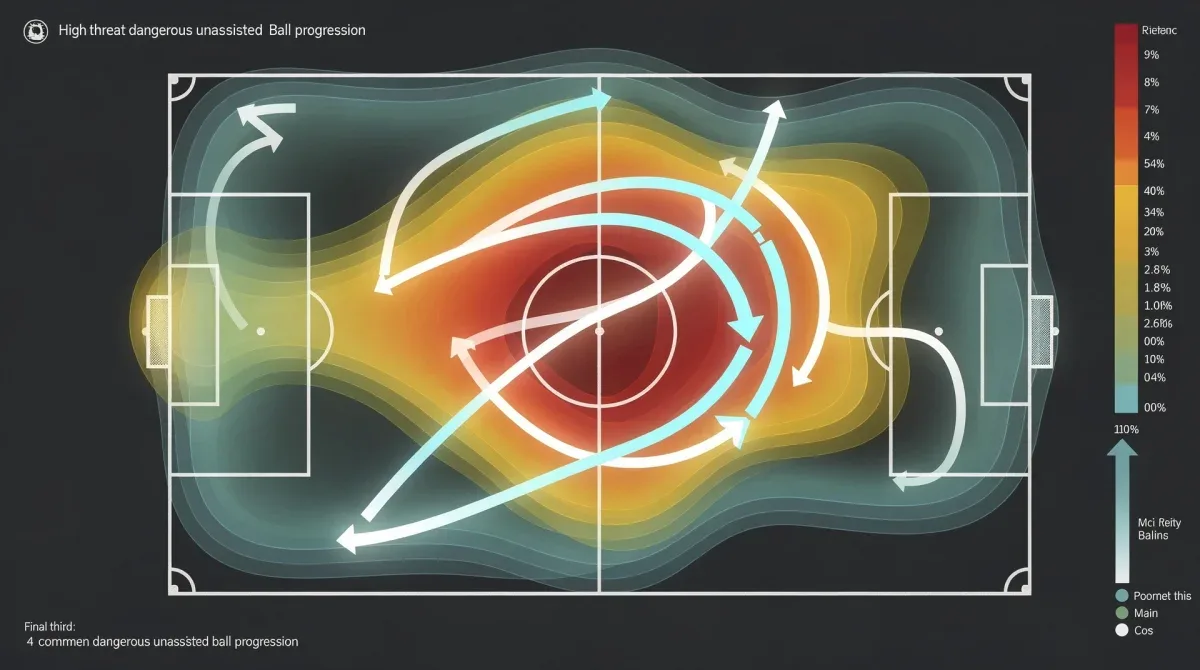
Machine learning models are trained on vast historical datasets to recognize the characteristics of actions that most frequently lead to goals. They learn to weigh various factors:
- Starting Position: How threatening was the initial ball location?
- Ending Position: How much more threatening is the new ball location?
- Defensive Pressure: How many opponents were bypassed or drawn out?
- Distance Covered: Was it a short, sharp burst or a long, sustained run?
- Direction of Progression: Was the ball moved towards the goal or laterally?
By considering these and other contextual factors, the models can accurately assess the 'danger' of each unassisted progression. The 85% figure suggests that the models have become highly adept at distinguishing between innocuous movements and those that genuinely put the opposition under pressure, providing a robust framework for performance evaluation.
This comprehensive approach ensures that analysts are not just counting dribbles but evaluating their quality and impact. It allows for a granular understanding of which players are most effective at creating danger through individual brilliance, offering valuable insights for both tactical planning and player development.
Practical applications in tactical analysis and player evaluation
The insights derived from quantifying dangerous unassisted ball progressions have profound practical applications across various facets of football, from refining team tactics to making informed decisions in player recruitment and development. This threat modeling guide emphasizes how these analytical advancements translate into tangible benefits on and off the pitch.
Enhancing tactical frameworks
Coaches can leverage xT data to understand their team's offensive strengths and weaknesses. By analyzing where and how their players generate the most threat through unassisted progressions, they can design training drills that reinforce effective movement patterns and identify areas for improvement. For example, if a team struggles to progress the ball centrally, specific drills can be implemented to encourage more effective carries and dribbles in those zones.
- Offensive Strategy: Identifying optimal zones for ball progression.
- Defensive Strategy: Pinpointing opponents' key ball carriers and their preferred progression routes.
- In-Game Adjustments: Using real-time data to inform substitutions and tactical shifts.
- Set-Piece Design: Understanding how ball progression from set-piece situations can maximize threat.
Furthermore, xT analysis allows for a detailed scouting of opposition teams. By understanding which players are most adept at creating danger through unassisted progressions and their typical patterns of movement, coaches can devise specific defensive schemes to neutralize these threats. This proactive approach to tactical planning provides a significant competitive advantage.
In player evaluation, xT metrics offer a more objective measure of a player's contribution than traditional statistics. A midfielder who consistently carries the ball into high-threat areas, even without directly assisting, will be recognized for their valuable contribution. This helps in identifying underrated talents and ensuring that players are valued for their true impact on the game.
Challenges and future directions in threat modeling
While threat modeling, particularly through xT, has revolutionized football analytics, it is not without its challenges. The dynamic nature of the sport and the constant evolution of tactics mean that models must continuously adapt and improve. Understanding these limitations and future directions is crucial for anyone engaging with this threat modeling guide.
Current limitations and areas for improvement
One significant challenge lies in accounting for off-ball movement and defensive positioning. While xT effectively quantifies ball actions, the influence of players without the ball on creating space or blocking passing lanes is harder to integrate. Models are constantly being refined to incorporate these complex interactions more accurately.

- Contextual Factors: Difficulty in fully capturing game state, fatigue, and opponent quality.
- Defensive Impact: Limited ability to quantify defensive actions that prevent threat generation.
- Data Granularity: The need for even more precise tracking data to capture subtle movements.
- Model Complexity: Balancing accuracy with interpretability for coaches and players.
Another area of focus is the integration of qualitative analysis with quantitative data. While numbers provide objective insights, the human element of understanding player psychology, team chemistry, and unpredictable moments remains vital. Future models aim to blend these aspects more seamlessly.
The future of threat modeling
The future of threat modeling points towards even more sophisticated models that incorporate real-time environmental factors, such as player fatigue, tactical formations, and even weather conditions. The goal is to create predictive models that can not only quantify current threat but also forecast potential future threats based on evolving game states.
Furthermore, advancements in artificial intelligence and deep learning are expected to lead to models that can identify novel patterns and insights currently beyond human comprehension. This continuous evolution will ensure that threat modeling remains at the cutting edge of football analytics, providing increasingly accurate and actionable insights for decision-makers.
| Key Concept | Brief Description |
|---|---|
| Expected Threat (xT) | A model that quantifies the value of every action on the ball based on its potential to increase the probability of a goal. |
| Unassisted Ball Progressions | Individual player actions like carries and dribbles that move the ball into a more dangerous area without a direct pass. |
| Grid-Based Analysis | The pitch is divided into cells, each assigned a historical goal probability, to calculate xT generation. |
| Tactical Applications | Using xT to refine offensive and defensive strategies, scout opponents, and evaluate player performance objectively. |
Frequently asked questions about threat modeling
What is Expected Threat (xT) in football analytics?▼Expected Threat (xT) is an advanced metric that quantifies the value of every action on the ball by measuring how much it increases the probability of a goal being scored. It assigns a numerical value to passes, dribbles, and carries based on the change in goal-scoring probability from the ball's starting to ending position.
How do analysts quantify dangerous unassisted ball progressions?▼Analysts quantify these progressions using xT models. They map the pitch into a grid, assigning goal probabilities to each cell. When a player carries or dribbles the ball, the model calculates the difference in xT value between the start and end points of the progression, revealing its danger.
Why is quantifying unassisted ball progressions important?▼Quantifying these progressions provides a deeper understanding of player impact beyond goals and assists. It highlights individual skill in breaking lines, creating space, and advancing play, which are crucial for offensive momentum and tactical effectiveness. It allows for a more comprehensive evaluation of player contributions.
What role does machine learning play in threat modeling?▼Machine learning algorithms are essential for training xT models on vast datasets of historical football events. They identify complex patterns and correlations between ball actions, positional data, and goal outcomes, enabling the models to accurately predict the threat level associated with various unassisted ball progressions.
How can threat modeling improve tactical analysis for coaches?▼Threat modeling helps coaches identify optimal areas for ball progression, understand individual player strengths in creating danger, and scout opponent vulnerabilities. It enables them to design targeted training drills, refine offensive and defensive strategies, and make data-driven decisions during games and in player recruitment.
Conclusion
The journey through this threat modeling guide underscores the revolutionary impact of advanced analytics on modern football. By meticulously quantifying the danger of unassisted ball progressions, analysts provide an unparalleled depth of insight into player performance and tactical dynamics. The Expected Threat (xT) framework, supported by robust data and machine learning, allows teams to move beyond superficial statistics, identifying the true value of individual actions that contribute to goal-scoring opportunities. As the sport continues to embrace data-driven strategies, threat modeling will undoubtedly remain a cornerstone of analytical excellence, continually refining our understanding of the beautiful game.
