CONMEBOL World Cup Qualifying Standings: Road to 2026
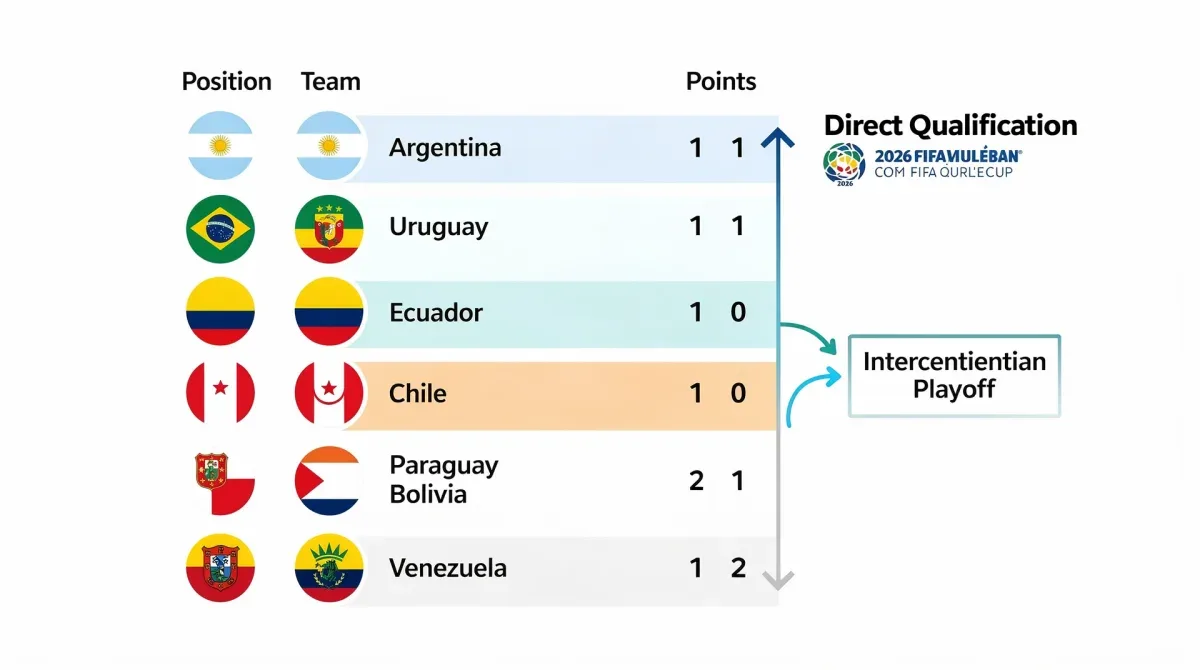
The CONMEBOL World Cup Qualifying standings chart the challenging 18-round journey for South American nations, battling fiercely for six direct berths in the expanded 2026 FIFA World Cup, with one additional playoff spot available.
The race for FIFA World Cup qualification is arguably one of the most compelling narratives in international soccer, and nowhere is this more acutely felt than in South America. The CONMEBOL World Cup Qualifying standings reflect a grueling 18-round marathon where every point, every goal, and every match holds immense significance for national pride and global recognition.
Understanding the CONMEBOL World Cup Qualifying Format
The CONMEBOL World Cup Qualifying tournament is a unique spectacle, standing apart from other confederations due to its single, comprehensive league format. Unlike regions that utilize group stages followed by playoffs, CONMEBOL pits all ten national teams against each other in a true round-robin competition.
This structure guarantees that every nation faces every other nation twice – once at home and once away. This creates a level playing field, but also intensifies the pressure, as there are no easy fixtures or opportunities to avoid strong opponents. The sheer consistency required over 18 matchdays tests the depth, resilience, and tactical acumen of each squad and coaching staff.
The expanded 2026 World Cup and its impact
The 2026 FIFA World Cup will feature an unprecedented 48 teams, a significant expansion from the previous 32-team format. This change has directly impacted CONMEBOL, increasing the number of direct qualification slots available to South American nations. Previously, the confederation typically received 4 or 4.5 berths (with 0.5 signifying an inter-confederation playoff spot).
- Six Direct Slots: For 2026, CONMEBOL now boasts six guaranteed direct qualification spots. This means the top six teams in the final standings will automatically secure their place in the World Cup.
- One Playoff Spot: The seventh-placed team will enter an inter-confederation playoff, offering another chance to reach the global tournament. This expansion lessens the brutal competition slightly but still demands peak performance.
- Increased Opportunities: The additional spots provide more hope for teams traditionally on the bubble, potentially leading to even more competitive matches throughout the campaign.
This expanded format offers a fresh dynamic to the CONMEBOL World Cup Qualifying standings. While the traditional powerhouses like Brazil and Argentina remain strong contenders, the increased number of spots opens the door wider for other ambitious nations, making the race for qualification even more intriguing.
Analyzing the Current CONMEBOL World Cup Qualifying Standings
The CONMEBOL World Cup Qualifying standings are a constantly evolving tableau, reflecting the ebb and flow of form, injuries, and tactical adjustments throughout the campaign. Each matchday brings new narratives, unexpected upsets, and shifts in the table, keeping fans on the edge of their seats until the very last whistle.

Monitoring the current standings provides a snapshot of which teams are performing well and which are struggling. Points accumulation is paramount, but goal difference can also play a crucial role, especially in tight races for the final qualification spots. Teams must balance offensive ambition with defensive solidity to climb the table.
Key contenders and dark horses
Historically, Brazil and Argentina have dominated CONMEBOL qualifying, often securing their spots comfortably. Their star-studded squads and rich footballing traditions make them perennial favorites. However, the nature of the CONMEBOL qualifiers means no team can afford complacency.
- Brazil: Known for their flair and individual brilliance, Brazil consistently fields a strong team capable of dominating matches. Their ability to score goals and maintain a tight defense often sees them at the top of the standings.
- Argentina: With a blend of experienced veterans and emerging talent, Argentina's tactical discipline and competitive spirit make them formidable opponents. They often find ways to grind out results, even in challenging away fixtures.
- Uruguay: A resilient and physically imposing team, Uruguay often punches above its weight. Their strong defensive organization and clinical finishing make them a tough team to beat, especially at home.
- Colombia: Known for their technical players and fluid attacking style, Colombia can be a joy to watch when they hit their stride. Consistency is often their biggest challenge, but on their day, they can defeat any opponent.
- Ecuador: Often considered a dark horse, Ecuador leverages its home advantage in Quito's high altitude and has a squad capable of surprising bigger nations. Their athleticism and pace can cause significant problems for opponents.
Beyond these traditional contenders, nations like Chile, Paraguay, Peru, Bolivia, and Venezuela are all vying for a place. The expanded qualification spots mean that performances against direct rivals become even more critical, turning every encounter into a high-stakes affair. The CONMEBOL World Cup Qualifying standings are a testament to the competitive depth of South American football.
The Significance of Home and Away Form in CONMEBOL Qualifying
In CONMEBOL World Cup Qualifying, the distinction between home and away form is often stark and can significantly influence a team's position in the standings. The unique geographical and atmospheric conditions across South America create some of the most challenging away fixtures in international football.
Playing at home offers a distinct advantage, not just from the fervent support of the crowd, but also from familiarity with the pitch, climate, and travel logistics. Teams often build their qualification campaigns around maximizing points at home, knowing that away points are hard-earned.
High altitude and extreme climates
Several CONMEBOL nations play their home matches at significant altitudes, providing a considerable advantage over opponents accustomed to sea-level conditions. La Paz, Bolivia, for instance, sits at over 11,900 feet (3,600 meters) above sea level, making it notoriously difficult for visiting teams to perform at their peak due to the thin air.
- Altitude Advantage: Teams like Bolivia and Ecuador often rely heavily on their home form due to the physiological challenges presented by high-altitude venues. Visiting players experience fatigue much faster, impacting their stamina and decision-making.
- Climate Extremes: Beyond altitude, teams face a range of climatic conditions, from the intense heat and humidity of Manaus, Brazil, to the cold of Santiago, Chile, or the dry air of Mendoza, Argentina. Adapting to these varied environments adds another layer of complexity to away games.
- Travel Demands: The vast distances between South American countries mean extensive travel, often involving long flights and multiple time zone changes. This logistical burden can take a toll on players, affecting their recovery and preparation for matches.
Understanding these factors is crucial when analyzing the CONMEBOL World Cup Qualifying standings. A team might have a flawless home record but struggle on the road, while another might be adept at picking up crucial draws away from their base. These dynamics make every match a tactical battle, with coaches meticulously planning for both home advantages and away challenges.
The Impact of Key Players and Coaching Strategies
In a competition as demanding as the CONMEBOL World Cup Qualifying, the presence of generational talents and the tactical acumen of coaching staff are often the deciding factors in a team's success. The CONMEBOL World Cup Qualifying standings are not just a reflection of team performance, but also of individual brilliance and strategic foresight.
Key players can single-handedly change the outcome of a match with a moment of magic, whether it's a crucial goal, a game-saving tackle, or an inspiring leadership performance. Similarly, a coach's ability to adapt tactics, motivate players, and manage squad rotation over an 18-round campaign is indispensable.
Star players and their influence
South America consistently produces some of the world's best footballers, and their contributions to their national teams are often immense. Players like Lionel Messi for Argentina or Neymar for Brazil can elevate their teams, providing the creative spark or clinical finish needed to secure vital points.
- Leadership and Experience: Veteran players often bring invaluable experience and leadership, steadying the team during challenging moments and guiding younger talents. Their presence can be particularly impactful in high-pressure away games.
- Goal-Scoring Prowess: Strikers and attacking midfielders who consistently find the back of the net are critical. Their goals directly translate into points, pushing their teams up the CONMEBOL World Cup Qualifying standings.
- Defensive Anchors: Strong defenders and goalkeepers are equally important, providing the foundation upon which attacks are built. Their ability to shut down opposing offenses can be the difference between a win and a draw or loss.
Coaching philosophies and tactical battles
The coaching battles in CONMEBOL qualifying are as intense as the matches themselves. Each coach brings a unique philosophy and tactical approach, attempting to exploit opponent weaknesses while maximizing their own team's strengths. This often leads to fascinating tactical duels.
Some coaches might favor an aggressive, high-pressing style, while others might prioritize defensive solidity and counter-attacking. The ability to scout opponents effectively, make timely substitutions, and adapt formations during a game can swing momentum and secure crucial results. A coach's ability to manage player fatigue and morale throughout the long campaign is also vital, ensuring the team remains fresh and motivated for every fixture.
Historical Trends and Future Predictions for CONMEBOL Qualification
Examining historical trends in CONMEBOL World Cup Qualifying provides valuable insights into how teams typically perform and which patterns tend to emerge. While every campaign is unique, certain characteristics often repeat, offering a lens through which to view future predictions for the CONMEBOL World Cup Qualifying standings.
Historically, consistency has been key. Teams that maintain a steady performance level, avoid long losing streaks, and capitalize on their home advantage are usually the ones that qualify. The ability to bounce back from setbacks and maintain focus over the entire 18 rounds is a hallmark of successful qualifying campaigns.
Past campaigns and lessons learned
Looking back at previous qualifying cycles, we often see that the top two or three teams tend to establish a clear lead relatively early, while the battle for the remaining spots intensifies towards the end. The final matchdays are frequently characterized by dramatic finishes, with multiple teams still in contention for a direct berth or a playoff spot.
- Brazil and Argentina Dominance: These two giants have almost always qualified, often showcasing their superior squad depth and tactical consistency. Their historical performance sets a high bar for other nations.
- Emergence of New Powers: Over the years, teams like Colombia and Ecuador have shown they can consistently challenge the traditional powerhouses, demonstrating growth in their footballing infrastructure and player development.
- The Value of a Strong Start: While not definitive, a strong start can build momentum and confidence, allowing teams to navigate the later, more challenging fixtures with less pressure. However, a poor start is not insurmountable, as evidenced by several comebacks in past campaigns.
Forecasting the 2026 CONMEBOL World Cup Qualifying Standings
Predicting the final CONMEBOL World Cup Qualifying standings for 2026 involves considering several factors: the current form of key players, the stability of coaching staffs, the emergence of new talent, and the historical performance of nations. The expanded format with six direct spots and one playoff spot significantly alters the landscape.
While Brazil and Argentina are expected to qualify comfortably, the race for the remaining four direct spots and the playoff position will be fierce. Teams like Uruguay, Colombia, and Ecuador will likely be strong contenders. The performance of nations like Paraguay, Chile, and Peru, who often show flashes of brilliance but struggle with consistency, will be crucial. The increased number of slots means that even a seventh-place finish could lead to the World Cup via the inter-confederation playoff, adding another layer of excitement to the entire campaign.

The Road Ahead: Remaining Matches and Crucial Fixtures
As the CONMEBOL World Cup Qualifying campaign progresses, the focus inevitably shifts to the remaining matches and the crucial fixtures that will ultimately determine the final standings. Every game carries immense weight, with points at stake that can make or break a team's World Cup dreams.
The schedule often presents challenging sequences, such as back-to-back away games against strong opponents, or home fixtures against direct rivals. Navigating these periods successfully requires not only tactical prowess but also mental fortitude and squad depth to handle injuries and suspensions.
Must-win games and direct rivals
Certain matches are designated as 'six-pointers' – games against direct rivals who are also vying for a qualification spot. These fixtures often have double the impact, as winning not only gains points for your team but also denies them to a competitor. These are the games that truly shape the CONMEBOL World Cup Qualifying standings.
- Derby Matches: Traditional rivalries, such as Brazil vs. Argentina or Uruguay vs. Argentina, always carry extra significance. While these are often top-of-the-table clashes, the emotional intensity can sometimes lead to unexpected results.
- Mid-Table Clashes: For teams battling for the lower direct spots or the playoff position, matches against similarly ranked opponents become absolutely critical. A win in such a game can provide a significant boost, while a loss can be a major setback.
- Home Advantage Exploitation: Teams must make the most of their home fixtures, especially against teams they are expected to beat. Dropping points at home can be incredibly costly in such a tight competition.
The final rounds of CONMEBOL qualifying are always a spectacle of drama and tension. Teams often find themselves in do-or-die situations, where a single goal or a controversial referee decision can alter their destiny. Fans eagerly follow every result, knowing that the CONMEBOL World Cup Qualifying standings can shift dramatically with each passing matchday.
Fan Engagement and the Passion of CONMEBOL Qualifying
Beyond the tactical battles and player performances, the CONMEBOL World Cup Qualifying is deeply intertwined with the immense passion of South American football fans. The enthusiasm and dedication of supporters are unparalleled, creating an atmosphere that is both electrifying and intimidating, significantly impacting the CONMEBOL World Cup Qualifying standings.
For many, supporting their national team in the qualifiers is a matter of national pride and identity. The journey to the World Cup becomes a collective experience, uniting millions behind a common goal. This intense fan engagement adds another layer of drama and excitement to every match.
Atmosphere at stadiums and cultural significance
CONMEBOL qualifying matches are renowned for their incredible stadium atmospheres. Fans fill arenas with vibrant colors, thunderous chants, and a constant drumbeat of support. This passionate environment can be a significant advantage for home teams, providing an emotional lift and often unsettling visiting opponents.
- Unwavering Support: From Buenos Aires to Rio de Janeiro, and from Montevideo to Bogotá, stadiums become cauldrons of emotion. The energy from the stands is palpable, pushing players to greater heights.
- National Identity: For many South Americans, football is more than just a game; it's a reflection of their national identity and spirit. Success in qualifying brings immense joy and a sense of collective achievement.
- Global Following: The CONMEBOL qualifiers attract a global audience, drawn by the high quality of football, the dramatic narratives, and the sheer passion on display.
The cultural significance of the World Cup qualifiers in South America cannot be overstated. It's a period where entire nations pause to watch their heroes compete, hoping to secure a spot on the biggest stage in football. The journey through the CONMEBOL World Cup Qualifying standings is a shared experience, filled with hope, despair, and ultimately, triumph for those who make it.
| Key Aspect | Brief Description |
|---|---|
| Format | Single 18-round round-robin league among 10 nations. |
| 2026 World Cup Slots | 6 direct qualification spots, plus 1 inter-confederation playoff spot. |
| Home Advantage | Crucial due to altitude, climate, and passionate fan support across South America. |
| Key Factors | Player brilliance, coaching strategy, consistency, and tactical adaptation are vital. |
Frequently Asked Questions About CONMEBOL World Cup Qualifying
How many teams qualify directly from CONMEBOL for the 2026 World Cup?▼For the 2026 FIFA World Cup, CONMEBOL has been allocated six direct qualification spots. This means the top six teams in the final CONMEBOL World Cup Qualifying standings will automatically secure their places in the tournament, reflecting the expanded 48-team World Cup format.
What happens to the seventh-placed team in CONMEBOL qualifying?▼The team that finishes in seventh place in the CONMEBOL World Cup Qualifying standings will earn a spot in the inter-confederation playoffs. This playoff round offers an additional opportunity for teams from different confederations to compete for a limited number of remaining World Cup berths.
Why is CONMEBOL qualifying considered so difficult?▼CONMEBOL qualifying is renowned for its difficulty due to several factors: a challenging 18-round league format, intense rivalries, diverse geographical conditions (high altitude, extreme climates), extensive travel demands, and the high quality of competition among all ten South American nations.
Which teams are typically the strongest contenders in CONMEBOL qualifying?▼Historically, Brazil and Argentina are the strongest and most consistent contenders, often finishing at the top of the CONMEBOL World Cup Qualifying standings. Other strong teams frequently include Uruguay, Colombia, and Ecuador, who consistently challenge for direct qualification spots or playoff berths.
How important is home advantage in CONMEBOL World Cup Qualifying?▼Home advantage is extremely important in CONMEBOL qualifying. Teams leverage passionate home crowds, familiarity with playing surfaces, and adaptation to specific climatic or altitude conditions, giving them a significant edge over visiting teams who often struggle with travel fatigue and environmental changes.
Conclusion
The CONMEBOL World Cup Qualifying standings represent one of the most enthralling and challenging competitions in international football. The 18-round marathon tests the physical and mental limits of every team, demanding consistency, tactical brilliance, and individual moments of genius. With six direct spots and one playoff opportunity for the 2026 FIFA World Cup, the stakes have never been higher. Every match, whether a fierce derby or a battle against a dark horse, contributes to a gripping narrative that captivates fans across South America and around the globe. The journey through these qualifiers is not just about reaching the World Cup; it's about national pride, cultural identity, and the relentless pursuit of footballing glory.
